


The Parlay ValueBet Tool helps you build parlays using ValueBet selections. In the ValueBet tools menu, this is the tool shown as Parlays.
A normal ValueBet is a single bet on one selection. A Parlay ValueBet combines multiple value selections into one single bet.
For the parlay to win, every selection inside the parlay must win. If even one selection loses, the whole parlay loses. This means Parlay ValueBets have higher variance than Straight ValueBets.
The goal is to combine selections with value and build a full parlay with positive expected value. You place one combined bet on one sportsbook, and the result can either win or lose.
How to use the Parlay ValueBet Tool step by step
1. Open the Parlay ValueBet Tool
Open the Parlays tool from the ValueBet tools menu.
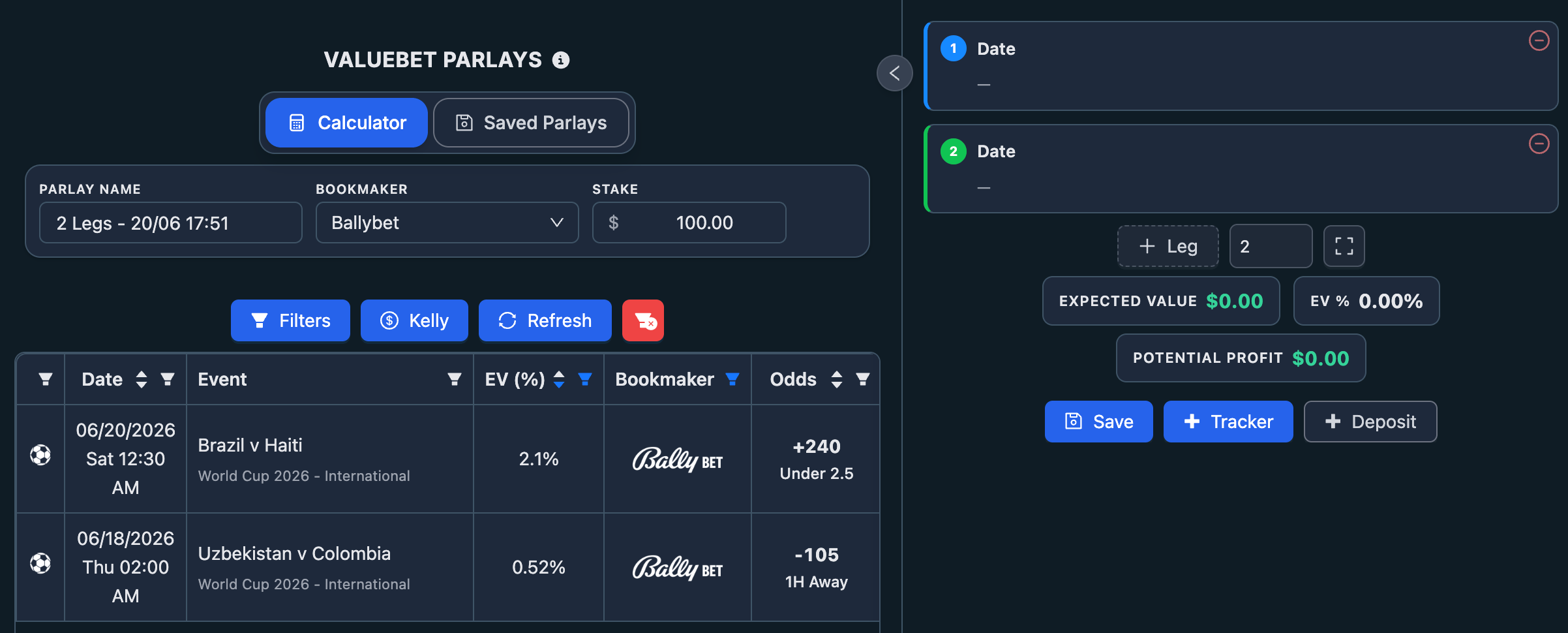
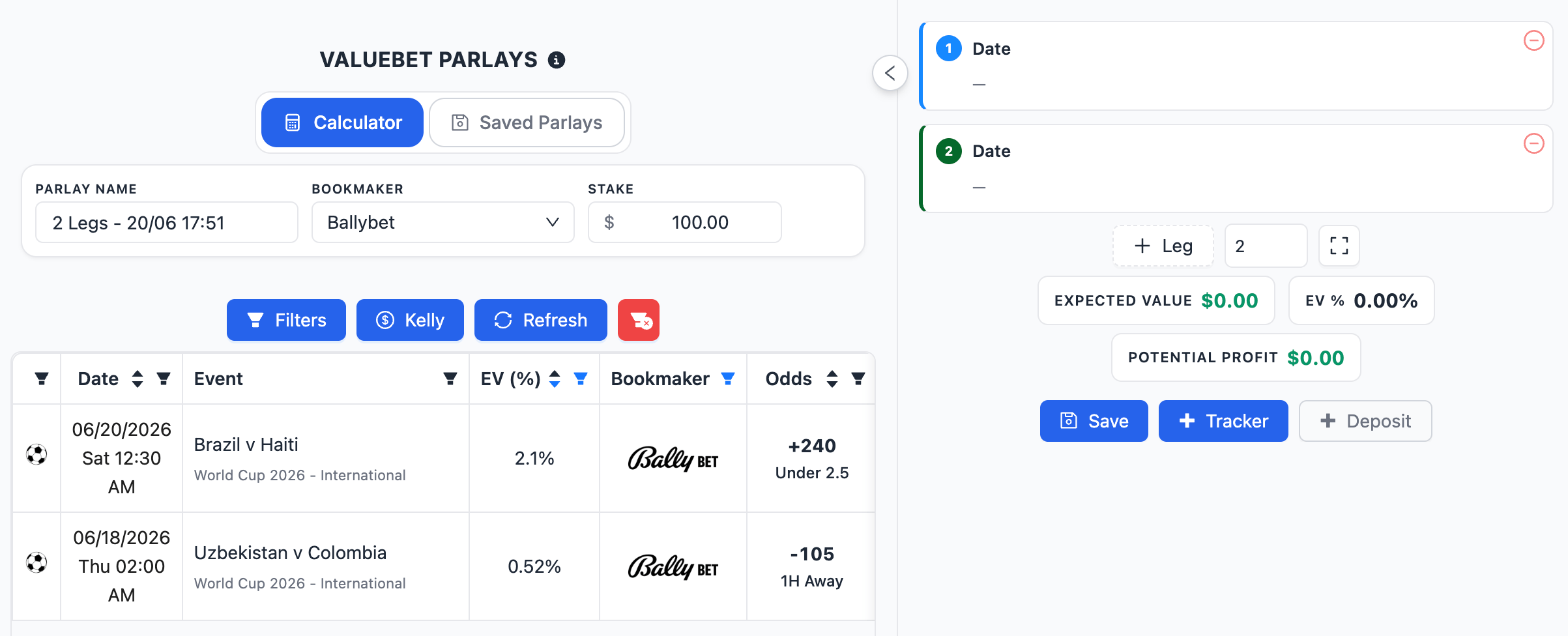
2. Add the selections
Build your parlay by adding selections. You may add selections from the available ValueBet table or enter them manually, depending on how you want to build the parlay.
Each selection is called a leg. A parlay must have at least two legs. For each leg, you should check:
- the event;
- the market;
- the selection;
- the sportsbook odds;
- the Fair Odds.
The odds and Fair Odds are important because the tool uses them to calculate the combined value of the parlay.
3. Review the combined odds
When you add multiple legs, the leg prices are combined into a single price.
For example:
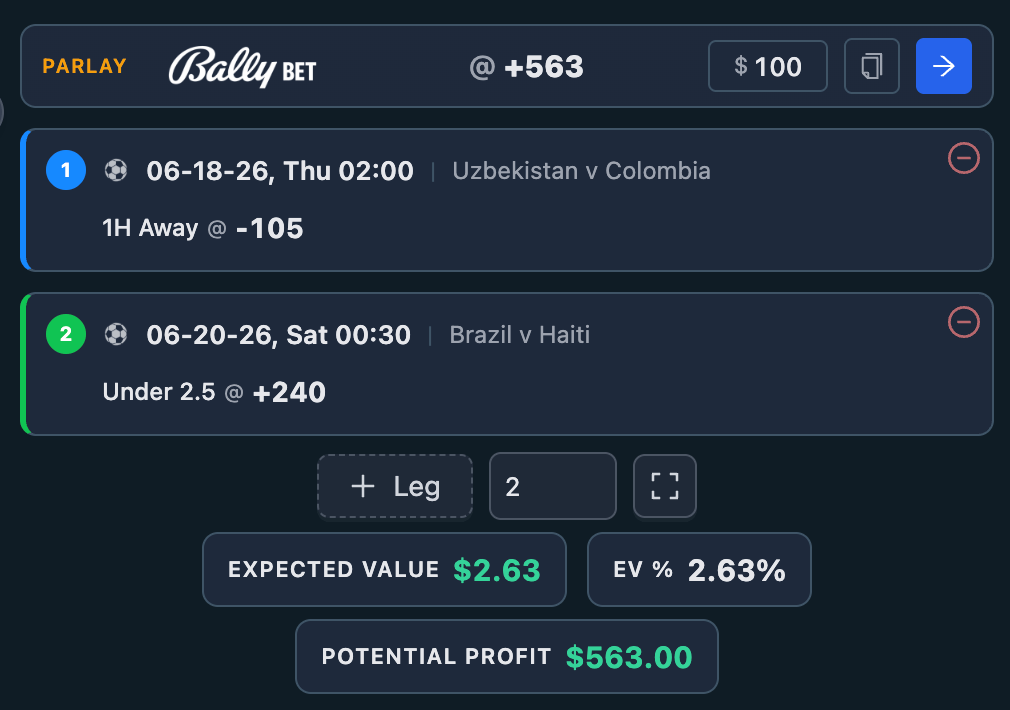
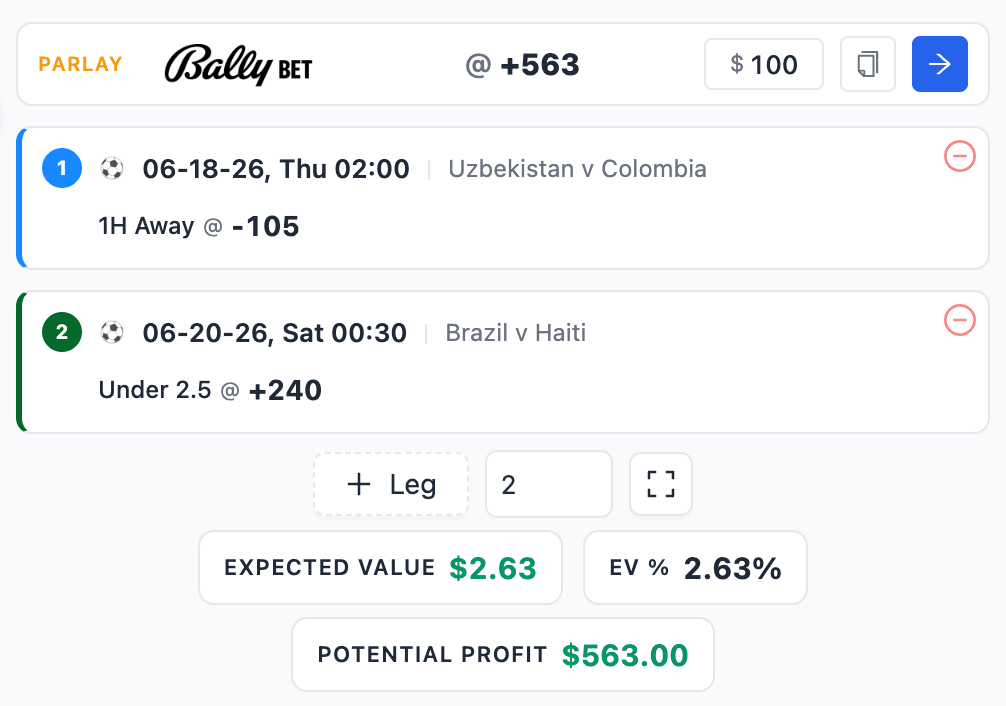
- Leg 1 odds: -105
- Leg 2 odds: +240
- Combined odds: +563
This means that the potential return is higher than a single bet. However, the chance of winning is lower because both selections must win.
4. Check the combined EV
The Parlay ValueBet Tool calculates the expected value of the full parlay. A parlay may have positive EV if the combined sportsbook odds are higher than the combined estimated fair value of the selections.
5. Choose the stake
After checking the EV, choose the stake for the parlay. Because parlays have higher variance than Straight ValueBets, the stake should usually be more conservative. Do not risk too much on one parlay.
The dedicated Bankroll and Kelly for ValueBet guide explains staking in more detail, but the basic rule is simple:
The higher the variance, the more careful you should be with the stake.
6. Check the parlay on the sportsbook
Before placing the bet, open the sportsbook and check that every leg matches. You should verify:
- each event;
- each market;
- each selection;
- each odd;
- the full combined odds;
- whether the sportsbook accepts the parlay;
- whether the sportsbook accepts your stake.
This step is very important because odds can change quickly. If one leg changes, the value of the full parlay changes.
7. Place the parlay
If everything matches, place the parlay with the selected stake.
8. Save and track the parlay
After placing it, save the parlay and record it in the Bet Tracker. Tracking is important because parlays can have strong short-term swings. You need to evaluate them over time, not from one single result.
What data is shown in the Parlay ValueBet Tool
The Parlay ValueBet Tool shows the information needed to build and evaluate a ValueBet parlay.
The tool shows:
- the selected legs;
- the sportsbook;
- the event;
- the market;
- the selection;
- the odds for each leg;
- the Fair Odds for each leg;
- the combined odds;
- the combined EV;
- the potential profit;
- the suggested or selected stake.
Each leg matters. If one leg has incorrect odds, a different market, or no real value, the full parlay can become weaker or even lose its expected value.
The most important values to check are:
- the odds of each leg;
- the Fair Odds of each leg;
- the combined odds;
- the EV of the full parlay.
Straight ValueBet vs Parlay ValueBet
The Straight ValueBet Tool is used for single bets. Each opportunity is one selection on one sportsbook.
The Parlay ValueBet Tool is different because it combines multiple selections into one parlay.
For example, a Straight ValueBet could be:
- the Lakers moneyline at +110.
A Parlay ValueBet could be:
- the Lakers moneyline at +110;
- Over 220.5 total points in another game at -110;
- the Celtics moneyline at -150.
These selections are combined into one bet.
The difference is important:
- a Straight ValueBet can win if its single selection wins;
- a Parlay ValueBet wins only if all selections win;
- a Straight ValueBet has lower variance;
- a Parlay ValueBet has higher variance;
- a Parlay ValueBet can produce a larger payout, but it will lose more often.
For this reason, users should usually understand Straight ValueBets before using the Parlay ValueBet Tool.
Understanding combined odds and combined EV
In a parlay, the individual leg prices are combined into one single price. For example:
- Leg 1 odds: +120
- Leg 2 odds: -110
To combine American odds, the tool converts each price to its decimal form as an intermediate step, multiplies them, and converts the result back to American:
+120 → 2.20 and -110 → 1.91
2.20 × 1.91 = 4.20 (decimal), which is +320 in American odds
So the combined odds are +320. A $10 parlay at +320 would return:
$10 stake + $32.00 profit = $42.00
The potential profit would be:
$42.00 - $10 = $32.00
However, the potential profit is not the same as expected value.
The potential profit tells you how much you win if every leg wins. The EV tells you whether the parlay is expected to be profitable over many similar bets.
This is the key difference.
A parlay with high potential profit can still be a bad bet if the odds are not valuable. A parlay with positive EV is useful because the combined price appears better than the estimated fair value of the full combination.
Understanding Fair Odds in a parlay
Each leg has its own sportsbook odds and Fair Odds. The sportsbook odds are the odds offered by the sportsbook. The Fair Odds represent the estimated fair value of that selection. The Parlay ValueBet Tool uses these values to evaluate the full parlay.
In simple terms:
- if the sportsbook odds are higher than the Fair Odds, the leg has value;
- if multiple value legs are combined correctly, the full parlay also has value.
Filtering and choosing legs
The ValueBet table can help you find selections to add to your parlay. You can use filters to narrow the list by:
- sport;
- date;
- sportsbook;
- bet type;
- odds range;
- EV range;
- event;
- competition.
This helps you focus only on selections that are useful for your strategy. For example, you may want to show only:
- sportsbooks where you have funds;
- events starting today;
- sports you understand;
- selections above a certain EV;
- odds within a certain range;
- markets you are comfortable placing.
The goal is not to add as many legs as possible. The goal is to build a parlay with selections that make sense and can be verified correctly.
How to choose a good Parlay ValueBet
The best Parlay ValueBet is not always the one with the highest combined odds. A very high-odds parlay can look attractive, but it also has much higher variance.
When building a Parlay ValueBet, look at:
- the EV of the full parlay;
- the value of each individual leg;
- the number of legs;
- the combined odds;
- how recently the odds were updated;
- whether the sportsbook accepts the parlay;
- whether the sportsbook accepts your stake;
- whether each market is easy to verify.
A shorter parlay with strong value selections is often better than a long parlay with many weak legs. Adding more legs increases the potential payout, but it also lowers the chance of winning. You should not add legs just to make the payout bigger.
Staking and bankroll
Staking is especially important with Parlay ValueBets.
Parlays have higher variance than straight bets because every leg must win. This means you can lose several parlays in a row, even if they have positive expected value. For this reason, parlay stakes should usually be smaller than straight ValueBet stakes.
A good staking approach should protect your bankroll from losing streaks. If the tool suggests a stake, use it as a guide, but always consider your own bankroll and risk tolerance.
Be especially careful with:
- high combined odds;
- many-leg parlays;
- volatile sports or markets;
- sportsbooks with low stake limits;
- selections that are difficult to verify.
The dedicated Bankroll and Kelly for ValueBet guide explains staking methods in more detail. For this guide, the most important rule is:
Do not risk too much on one parlay.
Parlay ValueBet works through repetition and discipline, not through one oversized bet.
Common mistakes to avoid
Adding too many legs
Each extra leg increases the combined odds, but it also lowers the chance of winning. Long parlays are high variance. Keep parlays reasonable and avoid adding legs only to chase a large payout.
Looking only at potential profit
Potential profit shows what you can win if every leg wins. It does not tell you whether the parlay is good. Always check the EV of the full parlay.
Ignoring odds movement
If one leg changes before you place the bet, the value of the full parlay changes. Do not force the parlay if the odds are no longer available.
Confusing similar markets
Many markets look similar but settle differently. Always check the exact market, line, period, and rules for every leg.
Staking too much
Parlays can lose often. Do not risk too much on one parlay, even if the EV looks good.
Forgetting to track the parlay
After placing the parlay, record it in the Bet Tracker. Without tracking, it is difficult to understand your real results, expected value, and long-term performance.
Final summary
The Parlay ValueBet Tool allows you to combine multiple value selections into one single bet.
To use the Parlay ValueBet Tool correctly:
- Open the Parlays tool from the ValueBet menu.
- Add at least two value selections.
- Check the odds and Fair Odds for each leg.
- Review the combined odds and EV.
- Choose a sensible stake.
- Check every event, market, selection, and odd on the sportsbook.
- Confirm that the sportsbook accepts the parlay and the stake.
- Place the parlay only if everything matches.
- Record the parlay in the Bet Tracker.
A Parlay ValueBet can win or lose. The goal is to build parlays where the combined price appears favorable and repeat this process over time with disciplined staking.
Straight ValueBets are simpler and usually have lower variance. Parlay ValueBets can be useful, but they require more patience, more careful staking, and more attention before placing the bet.
How to use the Parlay ValueBet Tool step by step
1. Open the Parlay ValueBet Tool
Open the Parlays tool from the ValueBet tools menu.
2. Add the selections
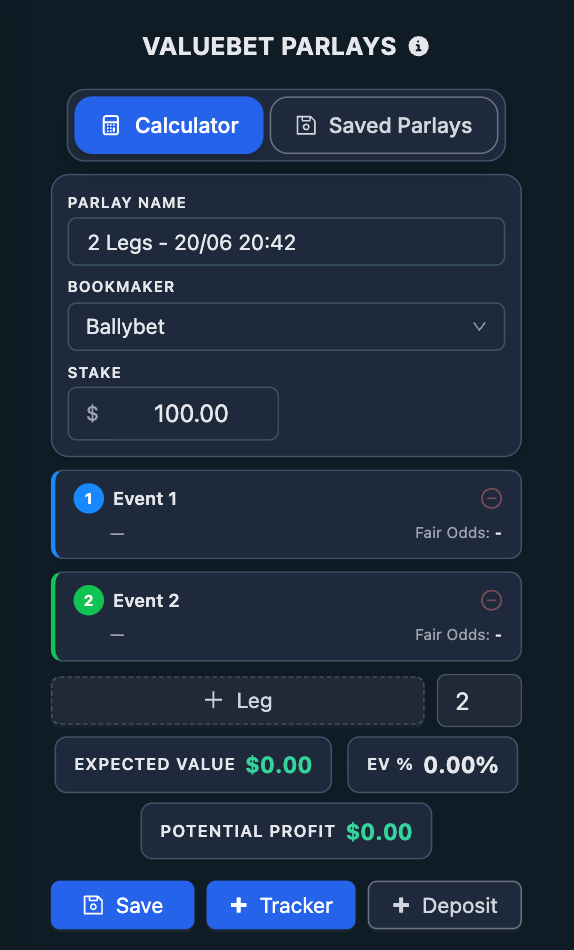
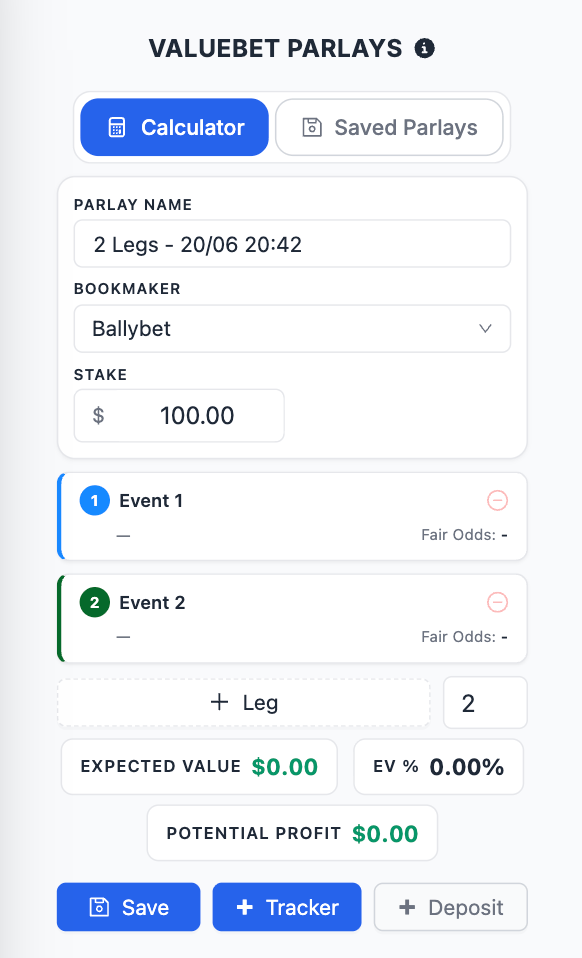
Build your parlay by adding selections. You may add selections from the available ValueBet table or enter them manually, depending on how you want to build the parlay.
Each selection is called a leg. A parlay must have at least two legs. For each leg, you should check:
- the event;
- the market;
- the selection;
- the sportsbook odds;
- the Fair Odds.
The odds and Fair Odds are important because the tool uses them to calculate the combined value of the parlay.
3. Review the combined odds
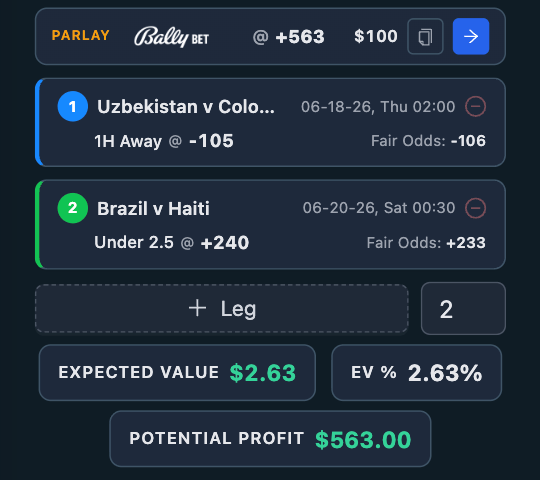
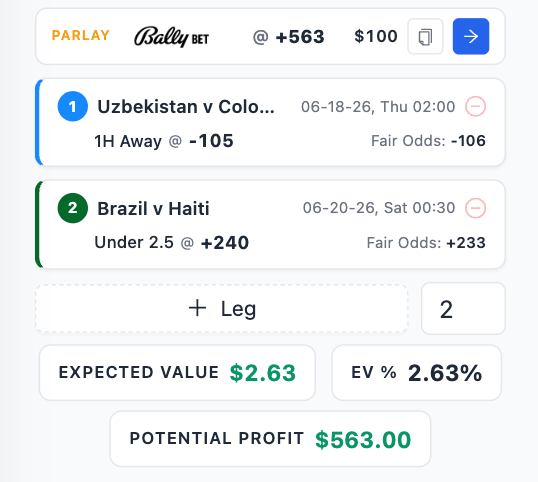
When you add multiple legs, the leg prices are combined into a single price.
For example:
- Leg 1 odds: -105
- Leg 2 odds: +240
- Combined odds: +563
This means that the potential return is higher than a single bet. However, the chance of winning is lower because both selections must win.
4. Check the combined EV
The Parlay ValueBet Tool calculates the expected value of the full parlay. A parlay may have positive EV if the combined sportsbook odds are higher than the combined estimated fair value of the selections.
5. Choose the stake
After checking the EV, choose the stake for the parlay. Because parlays have higher variance than Straight ValueBets, the stake should usually be more conservative. Do not risk too much on one parlay.
The dedicated Bankroll and Kelly for ValueBet guide explains staking in more detail, but the basic rule is simple:
The higher the variance, the more careful you should be with the stake.
6. Check the parlay on the sportsbook
Before placing the bet, open the sportsbook and check that every leg matches. You should verify:
- each event;
- each market;
- each selection;
- each odd;
- the full combined odds;
- whether the sportsbook accepts the parlay;
- whether the sportsbook accepts your stake.
This step is very important because odds can change quickly. If one leg changes, the value of the full parlay changes.
7. Place the parlay
If everything matches, place the parlay with the selected stake.
8. Save and track the parlay
After placing it, save the parlay and record it in the Bet Tracker. Tracking is important because parlays can have strong short-term swings. You need to evaluate them over time, not from one single result.
What data is shown in the Parlay ValueBet Tool
The Parlay ValueBet Tool shows the information needed to build and evaluate a ValueBet parlay.
The tool shows:
- the selected legs;
- the sportsbook;
- the event;
- the market;
- the selection;
- the odds for each leg;
- the Fair Odds for each leg;
- the combined odds;
- the combined EV;
- the potential profit;
- the suggested or selected stake.
Each leg matters. If one leg has incorrect odds, a different market, or no real value, the full parlay can become weaker or even lose its expected value.
The most important values to check are:
- the odds of each leg;
- the Fair Odds of each leg;
- the combined odds;
- the EV of the full parlay.
Straight ValueBet vs Parlay ValueBet
The Straight ValueBet Tool is used for single bets. Each opportunity is one selection on one sportsbook.
The Parlay ValueBet Tool is different because it combines multiple selections into one parlay.
For example, a Straight ValueBet could be:
- the Lakers moneyline at +110.
A Parlay ValueBet could be:
- the Lakers moneyline at +110;
- Over 220.5 total points in another game at -110;
- the Celtics moneyline at -150.
These selections are combined into one bet.
The difference is important:
- a Straight ValueBet can win if its single selection wins;
- a Parlay ValueBet wins only if all selections win;
- a Straight ValueBet has lower variance;
- a Parlay ValueBet has higher variance;
- a Parlay ValueBet can produce a larger payout, but it will lose more often.
For this reason, users should usually understand Straight ValueBets before using the Parlay ValueBet Tool.
Understanding combined odds and combined EV
In a parlay, the individual leg prices are combined into one single price. For example:
- Leg 1 odds: +120
- Leg 2 odds: -110
To combine American odds, the tool converts each price to its decimal form as an intermediate step, multiplies them, and converts the result back to American:
+120 → 2.20 and -110 → 1.91
2.20 × 1.91 = 4.20 (decimal), which is +320 in American odds
So the combined odds are +320. A $10 parlay at +320 would return:
$10 stake + $32.00 profit = $42.00
The potential profit would be:
$42.00 - $10 = $32.00
However, the potential profit is not the same as expected value.
The potential profit tells you how much you win if every leg wins. The EV tells you whether the parlay is expected to be profitable over many similar bets.
This is the key difference.
A parlay with high potential profit can still be a bad bet if the odds are not valuable. A parlay with positive EV is useful because the combined price appears better than the estimated fair value of the full combination.
Understanding Fair Odds in a parlay
Each leg has its own sportsbook odds and Fair Odds. The sportsbook odds are the odds offered by the sportsbook. The Fair Odds represent the estimated fair value of that selection. The Parlay ValueBet Tool uses these values to evaluate the full parlay.
In simple terms:
- if the sportsbook odds are higher than the Fair Odds, the leg has value;
- if multiple value legs are combined correctly, the full parlay also has value.
Filtering and choosing legs
The ValueBet table can help you find selections to add to your parlay. You can use filters to narrow the list by:
- sport;
- date;
- sportsbook;
- bet type;
- odds range;
- EV range;
- event;
- competition.
This helps you focus only on selections that are useful for your strategy. For example, you may want to show only:
- sportsbooks where you have funds;
- events starting today;
- sports you understand;
- selections above a certain EV;
- odds within a certain range;
- markets you are comfortable placing.
The goal is not to add as many legs as possible. The goal is to build a parlay with selections that make sense and can be verified correctly.
How to choose a good Parlay ValueBet
The best Parlay ValueBet is not always the one with the highest combined odds. A very high-odds parlay can look attractive, but it also has much higher variance.
When building a Parlay ValueBet, look at:
- the EV of the full parlay;
- the value of each individual leg;
- the number of legs;
- the combined odds;
- how recently the odds were updated;
- whether the sportsbook accepts the parlay;
- whether the sportsbook accepts your stake;
- whether each market is easy to verify.
A shorter parlay with strong value selections is often better than a long parlay with many weak legs. Adding more legs increases the potential payout, but it also lowers the chance of winning. You should not add legs just to make the payout bigger.
Staking and bankroll
Staking is especially important with Parlay ValueBets.
Parlays have higher variance than straight bets because every leg must win. This means you can lose several parlays in a row, even if they have positive expected value. For this reason, parlay stakes should usually be smaller than straight ValueBet stakes.
A good staking approach should protect your bankroll from losing streaks. If the tool suggests a stake, use it as a guide, but always consider your own bankroll and risk tolerance.
Be especially careful with:
- high combined odds;
- many-leg parlays;
- volatile sports or markets;
- sportsbooks with low stake limits;
- selections that are difficult to verify.
The dedicated Bankroll and Kelly for ValueBet guide explains staking methods in more detail. For this guide, the most important rule is:
Do not risk too much on one parlay.
Parlay ValueBet works through repetition and discipline, not through one oversized bet.
Common mistakes to avoid
Adding too many legs
Each extra leg increases the combined odds, but it also lowers the chance of winning. Long parlays are high variance. Keep parlays reasonable and avoid adding legs only to chase a large payout.
Looking only at potential profit
Potential profit shows what you can win if every leg wins. It does not tell you whether the parlay is good. Always check the EV of the full parlay.
Ignoring odds movement
If one leg changes before you place the bet, the value of the full parlay changes. Do not force the parlay if the odds are no longer available.
Confusing similar markets
Many markets look similar but settle differently. Always check the exact market, line, period, and rules for every leg.
Staking too much
Parlays can lose often. Do not risk too much on one parlay, even if the EV looks good.
Forgetting to track the parlay
After placing the parlay, record it in the Bet Tracker. Without tracking, it is difficult to understand your real results, expected value, and long-term performance.
Final summary
The Parlay ValueBet Tool allows you to combine multiple value selections into one single bet.
To use the Parlay ValueBet Tool correctly:
- Open the Parlays tool from the ValueBet menu.
- Add at least two value selections.
- Check the odds and Fair Odds for each leg.
- Review the combined odds and EV.
- Choose a sensible stake.
- Check every event, market, selection, and odd on the sportsbook.
- Confirm that the sportsbook accepts the parlay and the stake.
- Place the parlay only if everything matches.
- Record the parlay in the Bet Tracker.
A Parlay ValueBet can win or lose. The goal is to build parlays where the combined price appears favorable and repeat this process over time with disciplined staking.
Straight ValueBets are simpler and usually have lower variance. Parlay ValueBets can be useful, but they require more patience, more careful staking, and more attention before placing the bet.