


The SureBet Finder helps you find betting opportunities where all possible outcomes of an event can be covered with a profit.
A SureBet exists when the odds offered by different sportsbooks are high enough to create a positive return across the full operation. This means that, if the bets are placed correctly, the final result of the event does not affect the profit.
For example:
- On a two-outcome market, you may bet on the Lakers Moneyline at one sportsbook and the Celtics Moneyline at another.
- On a three-outcome market, such as an NHL 3-way regulation line, you may bet on Home Win, Tie, and Away Win across three different sportsbooks.
In both cases, the SureBet Finder shows the available combinations and calculates the stakes needed to complete the operation.
How to use the SureBet Finder step by step
1. Open the SureBet Finder
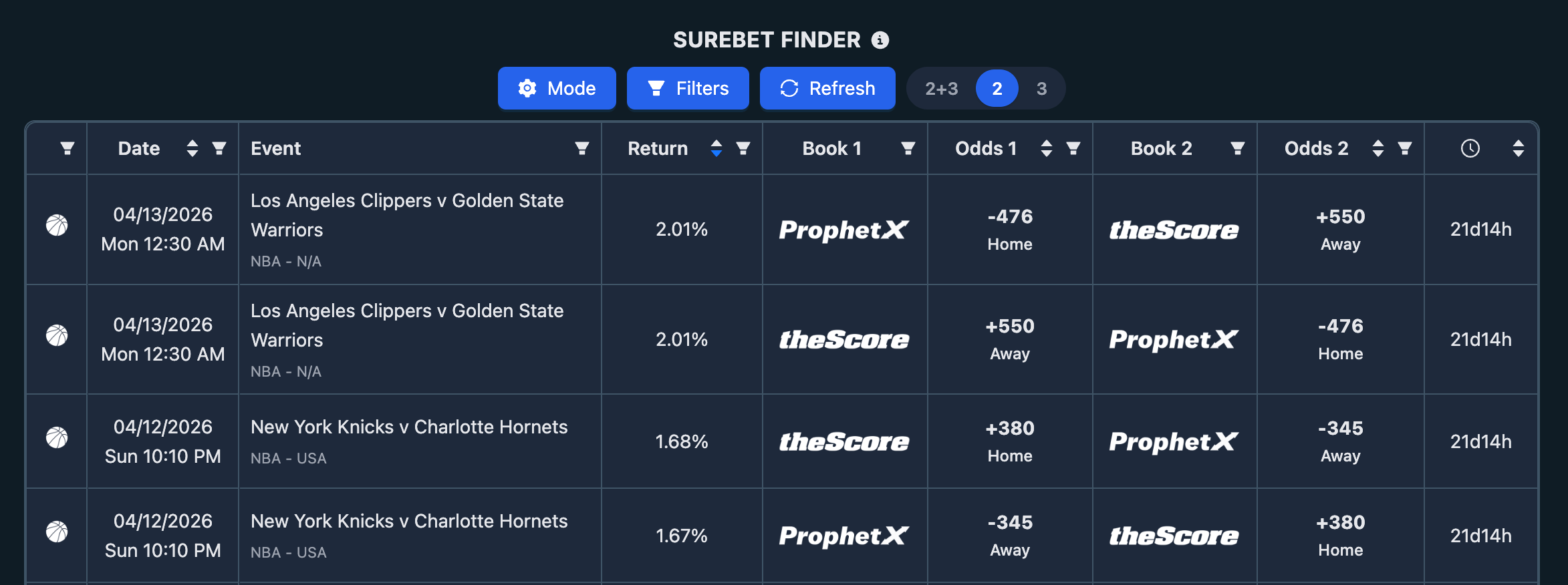
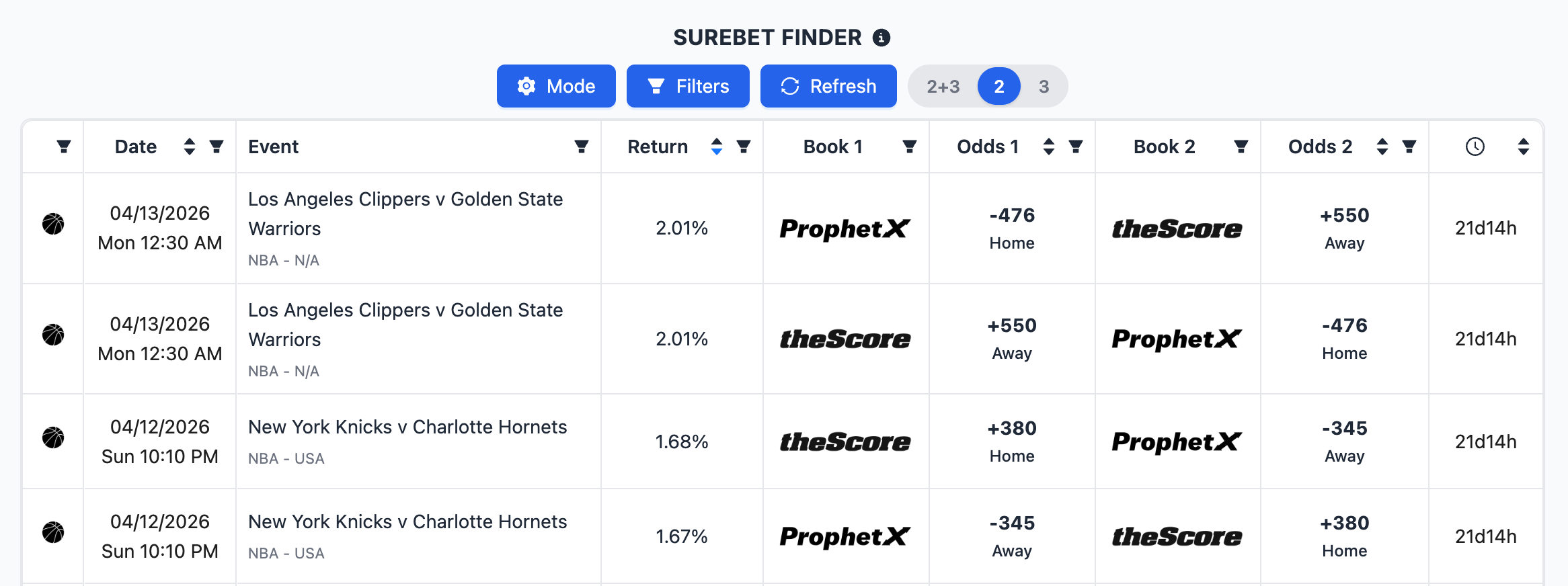
Open the SureBet Finder from the NinjaBet tools area. The table will show sportsbook combinations that generate SureBets.
2. Choose the stake mode
Before placing a SureBet, choose how you want to size the operation. The SureBet Finder has two main stake modes:
- Stake 1
- Total Stake
In Stake 1 mode, you enter the amount you want to place on Sportsbook 1. The calculator then shows the stakes for Sportsbook 2 and, when needed, Sportsbook 3.
This mode is useful when you want to control the stake on one specific sportsbook, or when that sportsbook has a stake limit.
In Total Stake mode, you enter the total amount you want to use for the full SureBet. The calculator then divides that amount across all the sportsbooks involved.
This mode is useful when you have a fixed budget for the whole operation.
3. Compare the available rows
After choosing the stake mode, compare the rows shown in the table. The most important column is Return, which indicates the profit percentage generated by the SureBet compared to the total stake.
For example:
- A return of 1% when betting $100 in total means the SureBet has an approximate profit of $1.
- A return of 1% when betting $300 in total means the SureBet has an approximate profit of $3.
- A return of 3% when betting $200 in total means the SureBet has an approximate profit of $6.
A higher return is better, but it is not the only thing that matters. You should also consider whether the sportsbooks are easy to use, whether the odds were updated recently, and whether you can place all the bets before the odds change.
4. Open the calculator
When you find a suitable row, click it to open the SureBet Calculator.
The calculator shows:
- the stake to place on Sportsbook 1;
- the stake to place on Sportsbook 2;
- the stake to place on Sportsbook 3, for three-outcome SureBets;
- the expected profit for each possible outcome;
- the overall return of the operation.
The calculator is the source of truth when placing the bets.
The table helps you find the opportunity. The calculator tells you exactly how to place it.
5. Check the bets on each sportsbook
Before placing any bet, open the event on every sportsbook involved and check that:
- the event is the same;
- the market is the same;
- the selections are correct;
- the odds still match the SureBet Finder;
- the stake is accepted by each sportsbook.
This step is very important.
SureBet odds can change quickly. A row that looks profitable in the table may no longer be profitable if one sportsbook has already changed the price.
6. Place the bets
Once everything is correct, place the bets using the stakes shown in the calculator.
Try to place the bets quickly, because SureBet opportunities can disappear in seconds.
7. Save the bets in the Bet Tracker
Once you have placed all bets, record the combination in the Bet Tracker so you can track profitability and sportsbook balances.
What data is shown in the SureBet Finder table
Each row in the SureBet Finder represents a sportsbook-to-sportsbook combination.


The table includes:
- Sport — the sport of the event.
- Date — the scheduled start date and time.
- Event — the match or event name.
- Return — the percentage return of the SureBet.
- Sportsbook 1 / Bet 1 / Odd 1 — the first sportsbook, selection, and odds.
- Sportsbook 2 / Bet 2 / Odd 2 — the second sportsbook, selection, and odds.
- Sportsbook 3 / Bet 3 / Odd 3 — shown only for three-outcome SureBets.
- Last Update — how recently the odds were refreshed.
The Last Update is important because odds can move quickly. A recent update is usually better, but you should still verify the odds directly on each sportsbook before placing the bets.
2, 3, and 2+3 Combinations
At the top of the SureBet Finder, you can choose which type of combinations to display:
- 2 — shows only two-leg combinations.
- 3 — shows only three-leg combinations.
- 2+3 — shows both types together.
2
This shows only two-outcome SureBets.
These are markets with two opposite outcomes, such as:
- Moneyline (2-way): Team A wins / Team B wins
- Totals: Over / Under
- Player prop: Over / Under
- Yes / No markets
Two-outcome SureBets are usually easier to place because you only need to place two bets.
3
This shows only three-outcome SureBets.
These are markets with three possible outcomes, such as an NHL 3-way regulation line:
- Home Win
- Tie
- Away Win
Three-outcome SureBets can be useful, but they require more attention because you need to place three bets across three sportsbooks.
2+3
This shows both two-outcome and three-outcome SureBets.
This is useful when you want to see the widest range of opportunities.
Stake 1 and Total Stake
The stake mode changes how the calculator builds the operation.
Stake 1
Use Stake 1 when you want to decide the amount placed on Sportsbook 1.
For example, you may want to place $100 on Sportsbook 1 because that sportsbook accepts that stake, or because you want to control how much money you use on that account.
The calculator will then calculate the correct stake for the other sportsbook or sportsbooks.
Total Stake
Use Total Stake when you want to decide the total amount used for the whole operation.
For example, if you enter $300 as the total stake, the calculator will divide that $300 between all the outcomes.
This is useful when you want to control your total exposure instead of controlling one specific leg.
Filtering the SureBet Finder
The SureBet Finder gives you different ways to filter the results.
You can use filters to narrow the table by:
- sport;
- date;
- sportsbook;
- bet type;
- odds range;
- return range;
- event;
- competition.
This helps you focus only on opportunities that are useful for you.
For example, you may want to see only SureBets from sportsbooks where you already have funds, or only events starting today, or only returns above a certain percentage.
You can also use filters directly from the table columns to refine the results quickly.
Searching for or hiding events
You can search for specific events, teams, or competitions.
This is useful when you want to focus on one match or when you only want to work with certain leagues.
You can also hide events or competitions that are not useful to you.
For example, you may want to hide events from leagues you do not trust, markets you do not understand, or sportsbooks where you cannot place the required stake.
Hiding irrelevant events makes the table easier to use and helps you focus on better opportunities.
How to choose the best SureBet
The best SureBet is not always the one with the highest return.
A very high return can be attractive, but it may also disappear quickly or come from a sportsbook error. It may also be harder to place if the sportsbook limits the stake or changes the odds before you complete the operation.
When choosing a SureBet, look at:
- the return;
- how recently the odds were updated;
- whether you can use the sportsbooks involved;
- whether you have enough balance on each sportsbook;
- whether the market is easy to find;
- whether the stake is accepted;
- whether the event and market are simple to verify.
A slightly lower return on a stable, easy-to-place opportunity is often better than a higher return that is difficult to execute correctly.
Using the SureBet Calculator
When you click a row, the SureBet Calculator opens and shows the exact betting plan.
The calculator uses the stake mode selected in the settings, but you can still edit the values if needed.
You can adjust:
- the stake on Sportsbook 1;
- the total stake;
- the odds;
- any commission or settings available in the calculator.
The calculator shows the expected result for every possible outcome.
If rounded stakes are enabled, the profit may not be exactly equal on every outcome, so always review the final result before placing the bets.
Example
Imagine the SureBet Finder shows a two-outcome SureBet with a return of 2%.
You select Stake 1 mode and enter $100 as the stake on Sportsbook 1.
The calculator then shows the stake needed on Sportsbook 2.
For example:
- Sportsbook 1: Over 220.5 Total Points
- Sportsbook 2: Under 220.5 Total Points
You open the event on both sportsbooks and check that the game, market, selections, and odds are correct.
If everything matches, you place both bets using the stakes shown in the calculator.
Whichever side wins, the final result should be positive.
Important checks before placing the bets
Before placing a SureBet, always check the following.
The event must be identical
Make sure all sportsbooks refer to the same event. Do not rely only on the team names. Check the date, time, competition, and market.
The market must be identical
Make sure the market is exactly the same. For example, Over 220.5 Total Points and Over 222.5 Total Points are not the same market.
The selections must cover every outcome
For a SureBet to work, every possible outcome must be covered. If one outcome is missing, the operation is not complete and you are exposed to normal betting risk.
The odds must still be available
Always check the odds directly on the sportsbook before placing the bets. If one price has changed, go back to the calculator and recalculate before placing the operation.
The stake must be accepted
A SureBet only works if each sportsbook accepts the required stake. If one sportsbook accepts only a smaller stake, the operation may become unbalanced. In that case, adjust the stakes in the calculator or skip the opportunity.
Do not place the first bet before checking the others
Do not place the first bet until you have opened and checked every sportsbook involved. If you place one bet and then find that the second price is gone, the SureBet is no longer complete.
Use the correct stake mode
Make sure you know whether you are using Stake 1 or Total Stake. If you enter the wrong value, the stakes shown by the calculator may not match the operation you intended to place.
Do not look only at the return
A high return is useful, but it is not everything. You also need stable odds, accepted stakes, enough balance, and sportsbooks you can use.
Record the operation afterward
After placing the bets, record the operation in your Bet Tracker. This helps you keep track of stakes, profits, balances, and results.
Saving filters with the URL
The SureBet Finder can keep your filters and settings in the URL. This is useful if you want to save a specific search setup or return to the same filtered view later.
For example, you may create a view that only shows:
- specific sportsbooks;
- specific sports;
- a minimum return;
- two-outcome SureBets only.
You can then save or share that URL and come back to the same setup.
Final summary
The SureBet Finder helps you find sportsbook combinations where all possible outcomes can be covered with a positive return.
To use it correctly:
- Open the SureBet Finder.
- Choose the stake mode: Stake 1 or Total Stake.
- Filter the sportsbooks, sports, markets, and return range.
- Choose whether to view 2-leg, 3-leg, or 2+3 combinations.
- Compare the rows and look for a suitable return.
- Open the calculator.
- Check the event, market, selections, odds, and accepted stakes on every sportsbook.
- Place all bets using the stakes shown in the calculator.
- Record the operation in your Bet Tracker.
Used correctly, the SureBet Finder allows you to find arbitrage opportunities and calculate the correct stakes before placing the bets.
The most important thing is execution.
The tool finds the opportunity, but you must still check the sportsbooks, confirm the odds, and place every bet correctly.
How to use the SureBet Finder step by step
1. Open the SureBet Finder
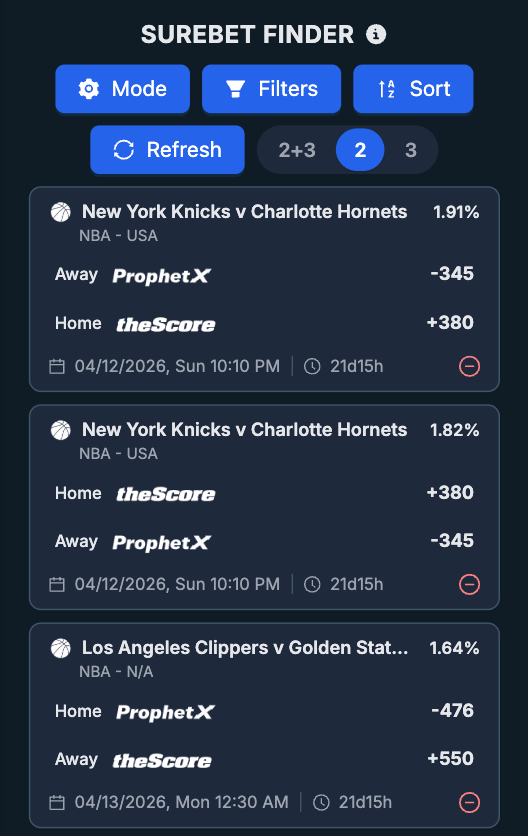
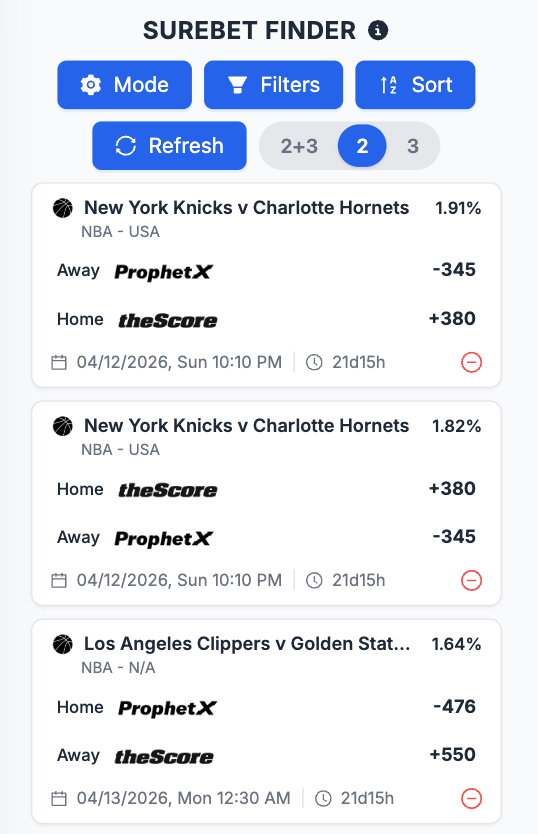
Open the SureBet Finder from the NinjaBet tools area. The table will show sportsbook combinations that generate SureBets.
2. Choose the stake mode
Before placing a SureBet, choose how you want to size the operation. The SureBet Finder has two main stake modes:
- Stake 1
- Total Stake
In Stake 1 mode, you enter the amount you want to place on Sportsbook 1. The calculator then shows the stakes for Sportsbook 2 and, when needed, Sportsbook 3.
This mode is useful when you want to control the stake on one specific sportsbook, or when that sportsbook has a stake limit.
In Total Stake mode, you enter the total amount you want to use for the full SureBet. The calculator then divides that amount across all the sportsbooks involved.
This mode is useful when you have a fixed budget for the whole operation.
3. Compare the available rows
After choosing the stake mode, compare the rows shown in the table. The most important column is Return, which indicates the profit percentage generated by the SureBet compared to the total stake.
For example:
- A return of 1% when betting $100 in total means the SureBet has an approximate profit of $1.
- A return of 1% when betting $300 in total means the SureBet has an approximate profit of $3.
- A return of 3% when betting $200 in total means the SureBet has an approximate profit of $6.
A higher return is better, but it is not the only thing that matters. You should also consider whether the sportsbooks are easy to use, whether the odds were updated recently, and whether you can place all the bets before the odds change.
4. Open the calculator
When you find a suitable row, click it to open the SureBet Calculator.
The calculator shows:
- the stake to place on Sportsbook 1;
- the stake to place on Sportsbook 2;
- the stake to place on Sportsbook 3, for three-outcome SureBets;
- the expected profit for each possible outcome;
- the overall return of the operation.
The calculator is the source of truth when placing the bets.
The table helps you find the opportunity. The calculator tells you exactly how to place it.
5. Check the bets on each sportsbook
Before placing any bet, open the event on every sportsbook involved and check that:
- the event is the same;
- the market is the same;
- the selections are correct;
- the odds still match the SureBet Finder;
- the stake is accepted by each sportsbook.
This step is very important.
SureBet odds can change quickly. A row that looks profitable in the table may no longer be profitable if one sportsbook has already changed the price.
6. Place the bets
Once everything is correct, place the bets using the stakes shown in the calculator.
Try to place the bets quickly, because SureBet opportunities can disappear in seconds.
7. Save the bets in the Bet Tracker
Once you have placed all bets, record the combination in the Bet Tracker so you can track profitability and sportsbook balances.
What data is shown in the SureBet Finder table
Each row in the SureBet Finder represents a sportsbook-to-sportsbook combination.
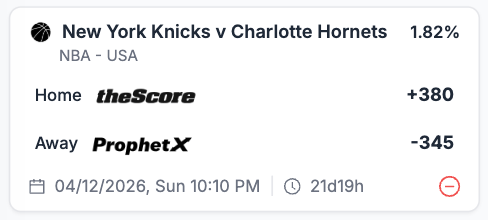
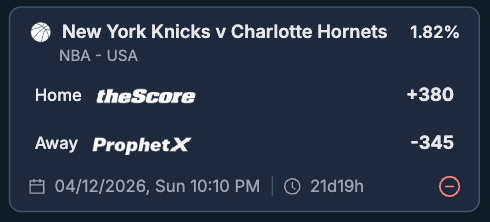
The table includes:
- Sport — the sport of the event.
- Date — the scheduled start date and time.
- Event — the match or event name.
- Return — the percentage return of the SureBet.
- Sportsbook 1 / Bet 1 / Odd 1 — the first sportsbook, selection, and odds.
- Sportsbook 2 / Bet 2 / Odd 2 — the second sportsbook, selection, and odds.
- Sportsbook 3 / Bet 3 / Odd 3 — shown only for three-outcome SureBets.
- Last Update — how recently the odds were refreshed.
The Last Update is important because odds can move quickly. A recent update is usually better, but you should still verify the odds directly on each sportsbook before placing the bets.
2, 3, and 2+3 Combinations
At the top of the SureBet Finder, you can choose which type of combinations to display:
- 2 — shows only two-leg combinations.
- 3 — shows only three-leg combinations.
- 2+3 — shows both types together.
2
This shows only two-outcome SureBets.
These are markets with two opposite outcomes, such as:
- Moneyline (2-way): Team A wins / Team B wins
- Totals: Over / Under
- Player prop: Over / Under
- Yes / No markets
Two-outcome SureBets are usually easier to place because you only need to place two bets.
3
This shows only three-outcome SureBets.
These are markets with three possible outcomes, such as an NHL 3-way regulation line:
- Home Win
- Tie
- Away Win
Three-outcome SureBets can be useful, but they require more attention because you need to place three bets across three sportsbooks.
2+3
This shows both two-outcome and three-outcome SureBets.
This is useful when you want to see the widest range of opportunities.
Stake 1 and Total Stake
The stake mode changes how the calculator builds the operation.
Stake 1
Use Stake 1 when you want to decide the amount placed on Sportsbook 1.
For example, you may want to place $100 on Sportsbook 1 because that sportsbook accepts that stake, or because you want to control how much money you use on that account.
The calculator will then calculate the correct stake for the other sportsbook or sportsbooks.
Total Stake
Use Total Stake when you want to decide the total amount used for the whole operation.
For example, if you enter $300 as the total stake, the calculator will divide that $300 between all the outcomes.
This is useful when you want to control your total exposure instead of controlling one specific leg.
Filtering the SureBet Finder
The SureBet Finder gives you different ways to filter the results.
You can use filters to narrow the table by:
- sport;
- date;
- sportsbook;
- bet type;
- odds range;
- return range;
- event;
- competition.
This helps you focus only on opportunities that are useful for you.
For example, you may want to see only SureBets from sportsbooks where you already have funds, or only events starting today, or only returns above a certain percentage.
Searching for or hiding events
You can search for specific events, teams, or competitions.
This is useful when you want to focus on one match or when you only want to work with certain leagues.
You can also hide events or competitions that are not useful to you.
For example, you may want to hide events from leagues you do not trust, markets you do not understand, or sportsbooks where you cannot place the required stake.
Hiding irrelevant events makes the table easier to use and helps you focus on better opportunities.
How to choose the best SureBet
The best SureBet is not always the one with the highest return.
A very high return can be attractive, but it may also disappear quickly or come from a sportsbook error. It may also be harder to place if the sportsbook limits the stake or changes the odds before you complete the operation.
When choosing a SureBet, look at:
- the return;
- how recently the odds were updated;
- whether you can use the sportsbooks involved;
- whether you have enough balance on each sportsbook;
- whether the market is easy to find;
- whether the stake is accepted;
- whether the event and market are simple to verify.
A slightly lower return on a stable, easy-to-place opportunity is often better than a higher return that is difficult to execute correctly.
Using the SureBet Calculator
When you click a row, the SureBet Calculator opens and shows the exact betting plan.
The calculator uses the stake mode selected in the settings, but you can still edit the values if needed.
You can adjust:
- the stake on Sportsbook 1;
- the total stake;
- the odds;
- any commission or settings available in the calculator.
The calculator shows the expected result for every possible outcome.
If rounded stakes are enabled, the profit may not be exactly equal on every outcome, so always review the final result before placing the bets.
Example
Imagine the SureBet Finder shows a two-outcome SureBet with a return of 2%.
You select Stake 1 mode and enter $100 as the stake on Sportsbook 1.
The calculator then shows the stake needed on Sportsbook 2.
For example:
- Sportsbook 1: Over 220.5 Total Points
- Sportsbook 2: Under 220.5 Total Points
You open the event on both sportsbooks and check that the game, market, selections, and odds are correct.
If everything matches, you place both bets using the stakes shown in the calculator.
Whichever side wins, the final result should be positive.
Important checks before placing the bets
Before placing a SureBet, always check the following.
The event must be identical
Make sure all sportsbooks refer to the same event. Do not rely only on the team names. Check the date, time, competition, and market.
The market must be identical
Make sure the market is exactly the same. For example, Over 220.5 Total Points and Over 222.5 Total Points are not the same market.
The selections must cover every outcome
For a SureBet to work, every possible outcome must be covered. If one outcome is missing, the operation is not complete and you are exposed to normal betting risk.
The odds must still be available
Always check the odds directly on the sportsbook before placing the bets. If one price has changed, go back to the calculator and recalculate before placing the operation.
The stake must be accepted
A SureBet only works if each sportsbook accepts the required stake. If one sportsbook accepts only a smaller stake, the operation may become unbalanced. In that case, adjust the stakes in the calculator or skip the opportunity.
Do not place the first bet before checking the others
Do not place the first bet until you have opened and checked every sportsbook involved. If you place one bet and then find that the second price is gone, the SureBet is no longer complete.
Use the correct stake mode
Make sure you know whether you are using Stake 1 or Total Stake. If you enter the wrong value, the stakes shown by the calculator may not match the operation you intended to place.
Do not look only at the return
A high return is useful, but it is not everything. You also need stable odds, accepted stakes, enough balance, and sportsbooks you can use.
Record the operation afterward
After placing the bets, record the operation in your Bet Tracker. This helps you keep track of stakes, profits, balances, and results.
Saving filters with the URL
The SureBet Finder can keep your filters and settings in the URL. This is useful if you want to save a specific search setup or return to the same filtered view later.
For example, you may create a view that only shows:
- specific sportsbooks;
- specific sports;
- a minimum return;
- two-outcome SureBets only.
You can then save or share that URL and come back to the same setup.
Final summary
The SureBet Finder helps you find sportsbook combinations where all possible outcomes can be covered with a positive return.
To use it correctly:
- Open the SureBet Finder.
- Choose the stake mode: Stake 1 or Total Stake.
- Filter the sportsbooks, sports, markets, and return range.
- Choose whether to view 2-leg, 3-leg, or 2+3 combinations.
- Compare the rows and look for a suitable return.
- Open the calculator.
- Check the event, market, selections, odds, and accepted stakes on every sportsbook.
- Place all bets using the stakes shown in the calculator.
- Record the operation in your Bet Tracker.
Used correctly, the SureBet Finder allows you to find arbitrage opportunities and calculate the correct stakes before placing the bets.
The most important thing is execution.
The tool finds the opportunity, but you must still check the sportsbooks, confirm the odds, and place every bet correctly.
Check out the discussion in the forum
Replies are posted on NinjaClub, our community forum — join the conversation there.
Reply on the forum