


The SureBet Calculator helps you calculate the exact stakes needed to complete a SureBet operation manually.
Unlike the SureBet Finder, the Calculator does not search for opportunities. Instead, you enter the odds, stake, and any commission manually, and the Calculator shows how much to place on each sportsbook and what the final result will be for every possible outcome.
When to use the SureBet Calculator
The SureBet Calculator is useful when:
- you already know the event and odds you want to use;
- you found a SureBet manually and need to calculate the correct stakes;
- the opportunity is not available in the SureBet Finder;
- you want to test how the result changes with different odds, stakes, or commissions;
- you want to adjust a SureBet after one stake has been limited or changed.
The SureBet Finder helps you discover opportunities. The SureBet Calculator helps you calculate them manually.
How to use the SureBet Calculator step by step
1. Open the Calculator
Open the SureBet Calculator from the NinjaBet tools area.
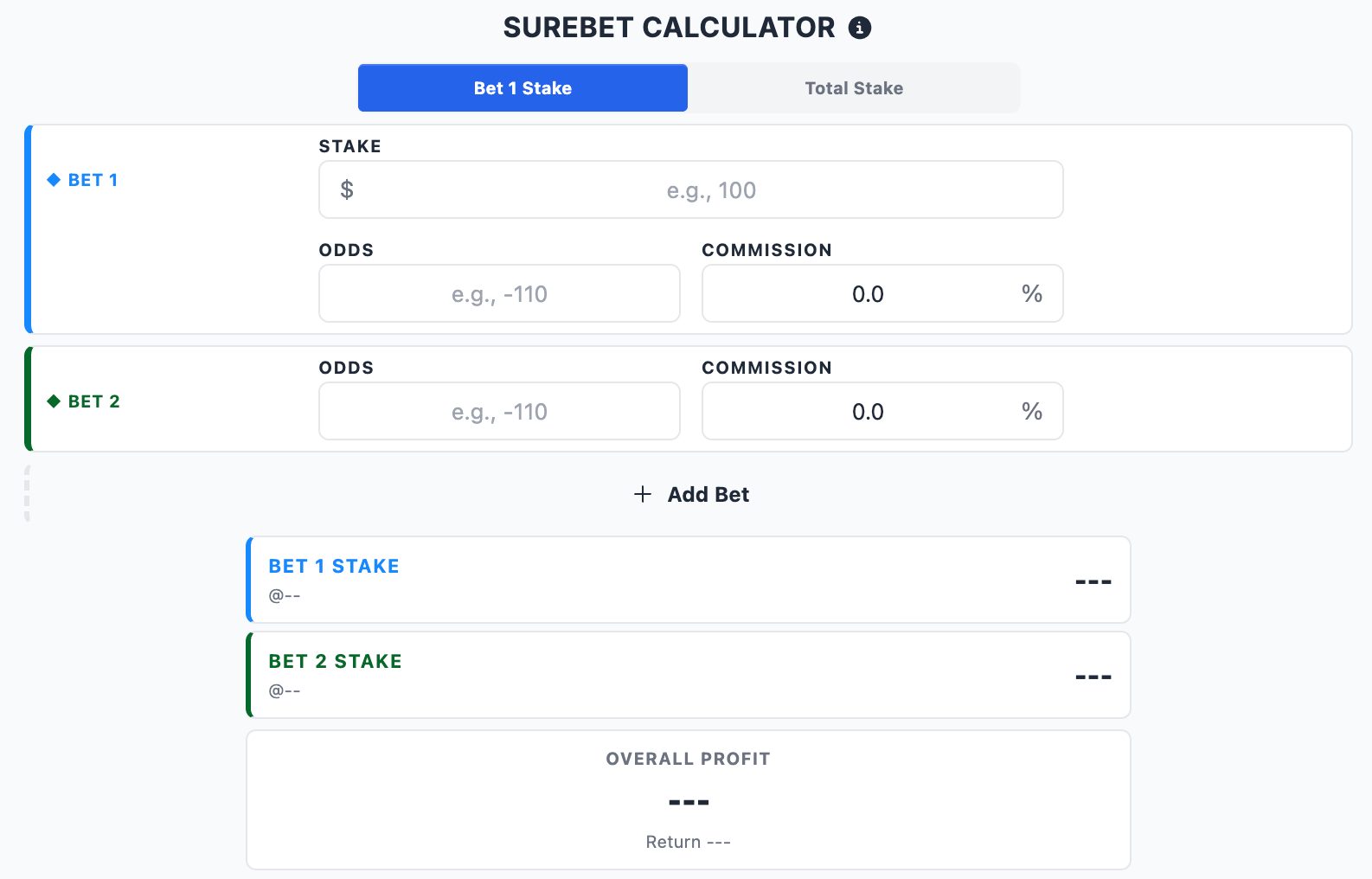
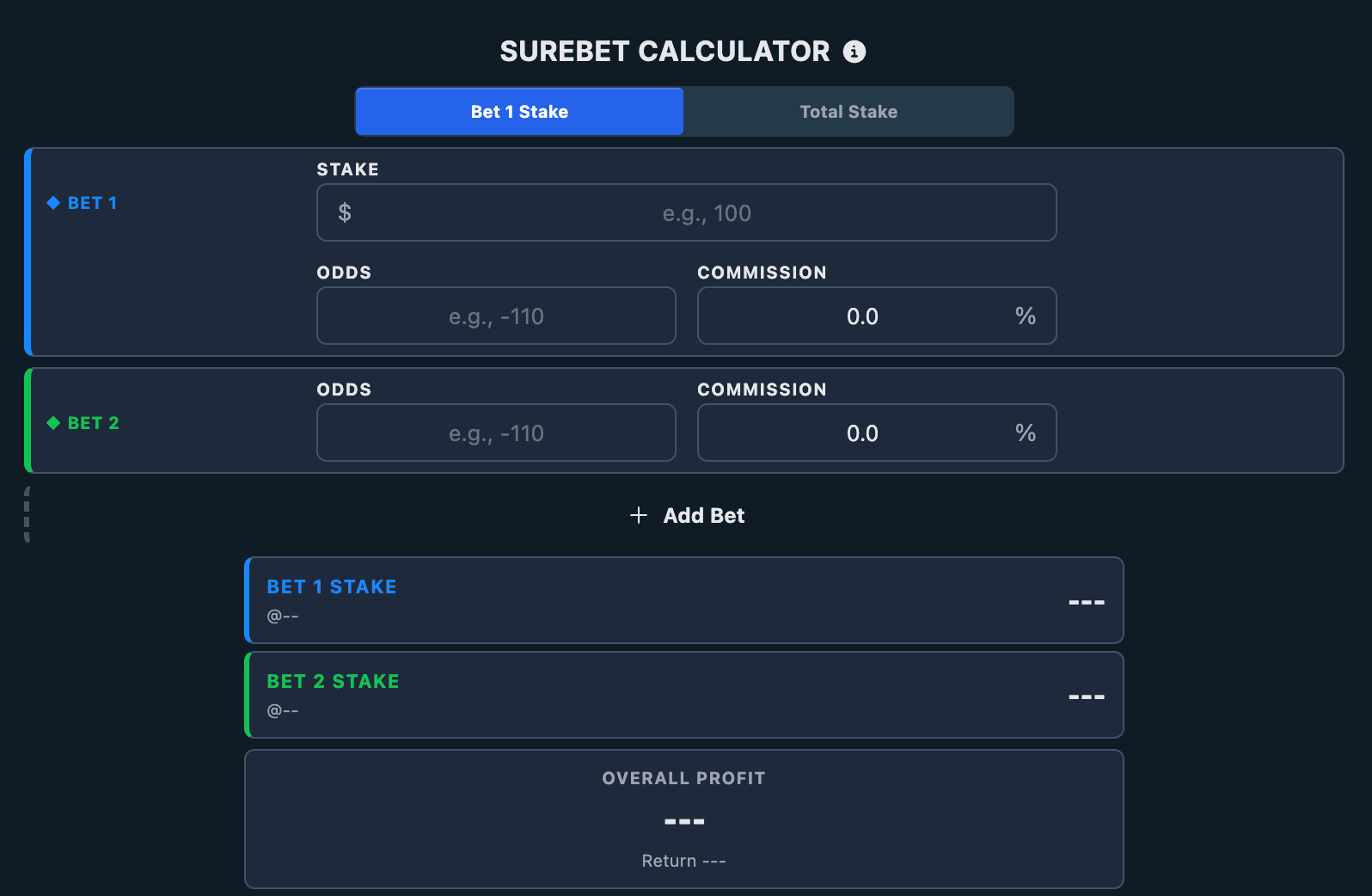
The Calculator lets you build the SureBet operation manually by choosing the stake type, entering the odds, adding the required betting legs, and checking the result for each possible outcome.
2. Select the stake type
Choose how you want to size the operation. The SureBet Calculator has two stake types:
- Bet 1 Stake
- Total Stake
Use Bet 1 Stake when you want to fix the amount placed on the first sportsbook. The Calculator will then calculate the stakes needed on the other sportsbook or sportsbooks.
Use Total Stake when you want to decide the total amount used for the whole operation. The Calculator will then divide that amount across all outcomes.
Choosing the correct stake type is important because it changes which value you enter and which values the Calculator produces.
3. Enter the bet details
Enter the values required for the calculation:
- the stake, depending on the selected stake type;
- the odds of Bet 1;
- the odds of Bet 2;
- the odds of Bet 3, if the market has three outcomes;
- any commission, if applicable.
The Calculator uses the values you enter manually. It does not search for odds or update them automatically.
4. Add the covering legs
Add as many bets as the market requires. You can add another bet with the + button and remove unnecessary legs when needed.
5. Read the results
Once the required fields are completed, the Calculator shows the result of the operation.
It shows:
- the stake to place on each sportsbook;
- the total stake of the operation;
- the expected result for each possible outcome;
- the overall profit or loss;
- the SureBet return.
The result area is the most important part of the Calculator. Before placing the bets, check that every possible outcome gives an acceptable result.
6. Place the bets
Before placing the bets, verify that the odds you entered still match the odds available on each sportsbook. If everything is correct, place the bets using the exact amounts shown by the Calculator.
SureBet opportunities can disappear quickly, so you should place the bets only after checking all sportsbooks involved.
7. Save the bets in the Bet Tracker
Once you have placed all bets, record the combination in the Bet Tracker so you can track profitability and sportsbook balances.
Bet 1 Stake and Total Stake
The SureBet Calculator can calculate the operation in two different ways.
Bet 1 Stake
Use Bet 1 Stake when you want to decide the amount placed on the first sportsbook.
For example, you may want to place $100 on Sportsbook 1 because that sportsbook accepts that stake, or because you want to control how much money you use on that account. The Calculator will then calculate the correct stake for the other sportsbook or sportsbooks.
Total Stake
Use Total Stake when you want to decide the total amount used for the full SureBet.
For example, if you enter $300 as the total stake, the Calculator will divide that $300 across all the outcomes.
Both modes can be useful. The right choice depends on how you want to size the operation.
Multiple bets
Some SureBets require more than two bets. This happens with markets that have more than two possible outcomes, such as a three-way line where a tie is possible:
- Home team wins
- Tie
- Away team wins
In this case, you need to cover all three outcomes for the operation to be complete.
The Calculator lets you add extra bets when needed. For each additional leg, enter the odds and any applicable commission. The Calculator will then recalculate the stakes so that the operation remains balanced according to the selected stake type.
Rounding amounts
If your account is set to Round amounts, the Calculator can round the stakes to make them easier to place. This can be useful because exact SureBet stakes are often unusual numbers, such as $47.83 or $52.17.
Rounded stakes are easier to place and can look more natural, but they can also slightly change the final result. When stakes are rounded or manually adjusted, the profit may no longer be exactly the same for every possible outcome. Always review the final scenario results before placing the bets.
Bet Not Accepted
The Calculator includes a Bet Not Accepted section to help you understand what happens if one of the bets is not placed or not accepted as planned.
This is very important for SureBet.
A SureBet only works when every required leg is placed correctly. If one sportsbook changes the odds, rejects the bet, or accepts only a smaller stake, the operation may no longer be balanced.
For example, you may place Bet 1 successfully, but then Sportsbook 2 may reduce the maximum stake or move the odds. In that case, the full operation changes.
The Bet Not Accepted section helps you understand the risk of an incomplete operation.
For a more detailed explanation, read the dedicated guide on how the Bet Not Accepted section works.
Important checks and common mistakes before placing the bets
Before confirming any SureBet operation, always check the full setup carefully. The Calculator uses the values you enter manually, so the result is only correct if the stake type, odds, markets, selections, commissions, and limits all match the real bets you are about to place.
1. Check the stake type
Make sure you are using the correct stake type: Bet 1 Stake or Total Stake. A Bet 1 Stake calculation and a Total Stake calculation are not the same. If you select the wrong one, the amounts shown by the Calculator may not match the operation you intended to place.
2. Check the event and market
Make sure every bet refers to the exact same game or event. Check the teams, date, time, league, and market. The market must also be identical. For example, Over 45.5 points and Under 45.5 points are opposite sides of the same market. But Over 45.5 points and Under 48.5 points are not the same market.
3. Check that every outcome is covered
For a SureBet to work, all possible outcomes must be covered. In a two-outcome market, both sides must be covered. In a three-outcome market, all three outcomes must be covered. If one outcome is missing, the operation is not a SureBet. It is a partial position with real risk.
4. Check the odds before placing the bets
The Calculator does not refresh odds automatically. It uses the odds you typed in manually. Always re-check the live odds on each sportsbook before placing the bets. SureBets can disappear quickly, and stale odds can turn a profitable operation into a bad one. Do not place the first bet until you have checked that the other odds are still available.
5. Check commission, limits, and balances
If one of your legs is on ProphetX, remember that ProphetX charges 2% commission on net winnings, so make sure the value entered in the Calculator matches what you actually pay. A small commission difference can change the final result, especially on tight SureBets. You should also make sure each sportsbook accepts the stake shown by the Calculator and that you have enough balance on every account involved. If one sportsbook accepts only a smaller stake, the operation may become unbalanced. In that case, adjust the stakes in the Calculator or skip the opportunity.
6. Check the final results
Before placing the bets, review the final result shown for every possible outcome. This is especially important if stakes have been rounded or manually adjusted, because the profit may no longer be exactly the same on every side. Do not place the bets unless the final scenario results are acceptable.
7. Do not look only at the profit
A SureBet is not only about the displayed profit. You also need correct markets, accepted stakes, enough balance, accurate commission, and odds that are still available. A slightly smaller profit on an easy and stable operation is often better than a higher profit that is difficult to place correctly.
Final summary
The SureBet Calculator is the tool to use when you already know the SureBet you want to place and need the exact stakes for each leg.
To use it correctly:
- Open the SureBet Calculator.
- Select the stake type: Bet 1 Stake or Total Stake.
- Enter the stake, odds, and any commission.
- Add extra bets when the market has more than two outcomes.
- Review the calculated stakes, rating, and scenario results.
- Verify the event, market, selections, odds, and limits.
- Place the bets using the exact amounts shown.
The Calculator does not find the opportunity for you. It helps you place the opportunity correctly once you already know the odds you want to use.
When to use the SureBet Calculator
The SureBet Calculator is useful when:
- you already know the event and odds you want to use;
- you found a SureBet manually and need to calculate the correct stakes;
- the opportunity is not available in the SureBet Finder;
- you want to test how the result changes with different odds, stakes, or commissions;
- you want to adjust a SureBet after one stake has been limited or changed.
The SureBet Finder helps you discover opportunities. The SureBet Calculator helps you calculate them manually.
How to use the SureBet Calculator step by step
1. Open the Calculator
Open the SureBet Calculator from the NinjaBet tools area.
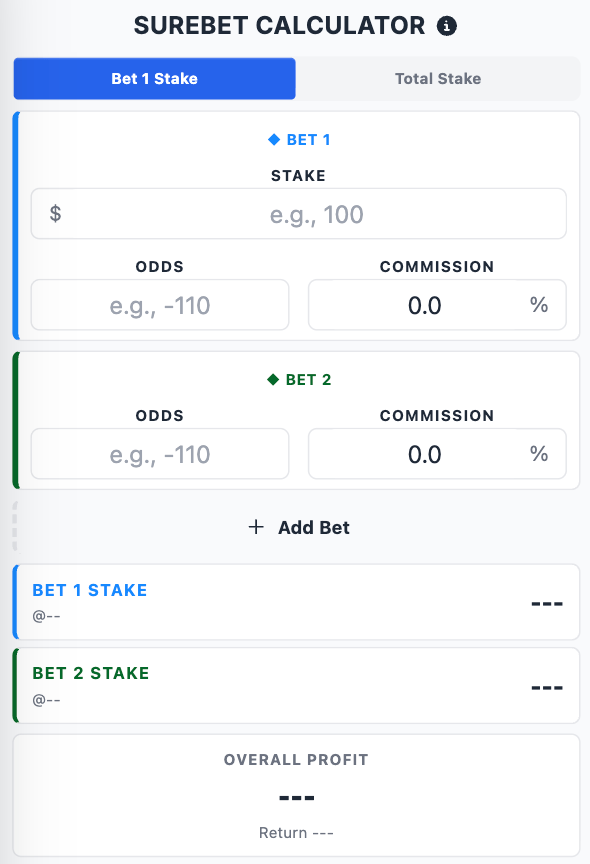
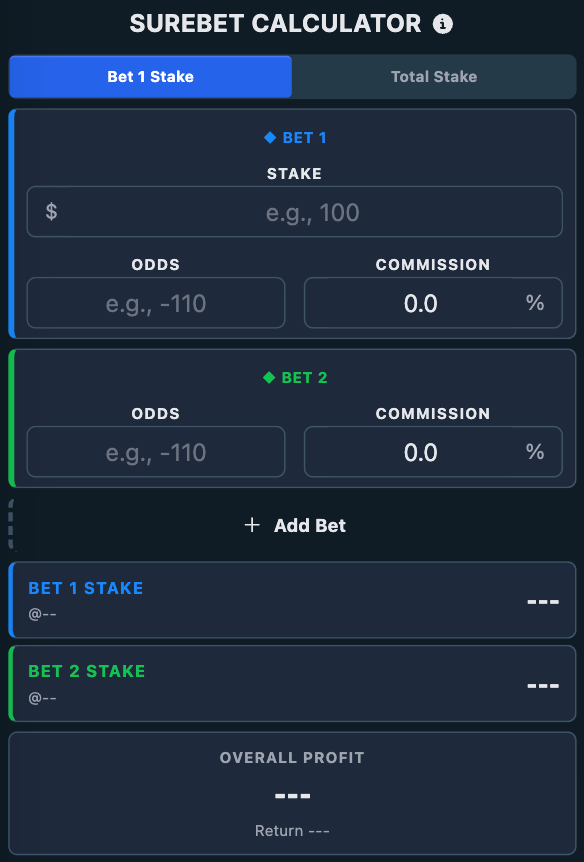
The Calculator lets you build the SureBet operation manually by choosing the stake type, entering the odds, adding the required betting legs, and checking the result for each possible outcome.
2. Select the stake type
Choose how you want to size the operation. The SureBet Calculator has two stake types:
- Bet 1 Stake
- Total Stake
Use Bet 1 Stake when you want to fix the amount placed on the first sportsbook. The Calculator will then calculate the stakes needed on the other sportsbook or sportsbooks.
Use Total Stake when you want to decide the total amount used for the whole operation. The Calculator will then divide that amount across all outcomes.
Choosing the correct stake type is important because it changes which value you enter and which values the Calculator produces.
3. Enter the bet details
Enter the values required for the calculation:
- the stake, depending on the selected stake type;
- the odds of Bet 1;
- the odds of Bet 2;
- the odds of Bet 3, if the market has three outcomes;
- any commission, if applicable.
The Calculator uses the values you enter manually. It does not search for odds or update them automatically.
4. Add the covering legs
Add as many bets as the market requires. You can add another bet with the + button and remove unnecessary legs when needed.
5. Read the results
Once the required fields are completed, the Calculator shows the result of the operation.
It shows:
- the stake to place on each sportsbook;
- the total stake of the operation;
- the expected result for each possible outcome;
- the overall profit or loss;
- the SureBet return.
The result area is the most important part of the Calculator. Before placing the bets, check that every possible outcome gives an acceptable result.
6. Place the bets
Before placing the bets, verify that the odds you entered still match the odds available on each sportsbook. If everything is correct, place the bets using the exact amounts shown by the Calculator.
SureBet opportunities can disappear quickly, so you should place the bets only after checking all sportsbooks involved.
7. Save the bets in the Bet Tracker
Once you have placed all bets, record the combination in the Bet Tracker so you can track profitability and sportsbook balances.
Bet 1 Stake and Total Stake
The SureBet Calculator can calculate the operation in two different ways.
Bet 1 Stake
Use Bet 1 Stake when you want to decide the amount placed on the first sportsbook.
For example, you may want to place $100 on Sportsbook 1 because that sportsbook accepts that stake, or because you want to control how much money you use on that account. The Calculator will then calculate the correct stake for the other sportsbook or sportsbooks.
Total Stake
Use Total Stake when you want to decide the total amount used for the full SureBet.
For example, if you enter $300 as the total stake, the Calculator will divide that $300 across all the outcomes.
Both modes can be useful. The right choice depends on how you want to size the operation.
Multiple bets
Some SureBets require more than two bets. This happens with markets that have more than two possible outcomes, such as a three-way line where a tie is possible:
- Home team wins
- Tie
- Away team wins
In this case, you need to cover all three outcomes for the operation to be complete.
The Calculator lets you add extra bets when needed. For each additional leg, enter the odds and any applicable commission. The Calculator will then recalculate the stakes so that the operation remains balanced according to the selected stake type.
Rounding amounts
If your account is set to Round amounts, the Calculator can round the stakes to make them easier to place. This can be useful because exact SureBet stakes are often unusual numbers, such as $47.83 or $52.17.
Rounded stakes are easier to place and can look more natural, but they can also slightly change the final result. When stakes are rounded or manually adjusted, the profit may no longer be exactly the same for every possible outcome. Always review the final scenario results before placing the bets.
Bet Not Accepted
The Calculator includes a Bet Not Accepted section to help you understand what happens if one of the bets is not placed or not accepted as planned.
This is very important for SureBet.
A SureBet only works when every required leg is placed correctly. If one sportsbook changes the odds, rejects the bet, or accepts only a smaller stake, the operation may no longer be balanced.
For example, you may place Bet 1 successfully, but then Sportsbook 2 may reduce the maximum stake or move the odds. In that case, the full operation changes.
The Bet Not Accepted section helps you understand the risk of an incomplete operation.
For a more detailed explanation, read the dedicated guide on how the Bet Not Accepted section works.
Important checks and common mistakes before placing the bets
Before confirming any SureBet operation, always check the full setup carefully. The Calculator uses the values you enter manually, so the result is only correct if the stake type, odds, markets, selections, commissions, and limits all match the real bets you are about to place.
1. Check the stake type
Make sure you are using the correct stake type: Bet 1 Stake or Total Stake. A Bet 1 Stake calculation and a Total Stake calculation are not the same. If you select the wrong one, the amounts shown by the Calculator may not match the operation you intended to place.
2. Check the event and market
Make sure every bet refers to the exact same game or event. Check the teams, date, time, league, and market. The market must also be identical. For example, Over 45.5 points and Under 45.5 points are opposite sides of the same market. But Over 45.5 points and Under 48.5 points are not the same market.
3. Check that every outcome is covered
For a SureBet to work, all possible outcomes must be covered. In a two-outcome market, both sides must be covered. In a three-outcome market, all three outcomes must be covered. If one outcome is missing, the operation is not a SureBet. It is a partial position with real risk.
4. Check the odds before placing the bets
The Calculator does not refresh odds automatically. It uses the odds you typed in manually. Always re-check the live odds on each sportsbook before placing the bets. SureBets can disappear quickly, and stale odds can turn a profitable operation into a bad one. Do not place the first bet until you have checked that the other odds are still available.
5. Check commission, limits, and balances
If one of your legs is on ProphetX, remember that ProphetX charges 2% commission on net winnings, so make sure the value entered in the Calculator matches what you actually pay. A small commission difference can change the final result, especially on tight SureBets. You should also make sure each sportsbook accepts the stake shown by the Calculator and that you have enough balance on every account involved. If one sportsbook accepts only a smaller stake, the operation may become unbalanced. In that case, adjust the stakes in the Calculator or skip the opportunity.
6. Check the final results
Before placing the bets, review the final result shown for every possible outcome. This is especially important if stakes have been rounded or manually adjusted, because the profit may no longer be exactly the same on every side. Do not place the bets unless the final scenario results are acceptable.
7. Do not look only at the profit
A SureBet is not only about the displayed profit. You also need correct markets, accepted stakes, enough balance, accurate commission, and odds that are still available. A slightly smaller profit on an easy and stable operation is often better than a higher profit that is difficult to place correctly.
Final summary
The SureBet Calculator is the tool to use when you already know the SureBet you want to place and need the exact stakes for each leg.
To use it correctly:
- Open the SureBet Calculator.
- Select the stake type: Bet 1 Stake or Total Stake.
- Enter the stake, odds, and any commission.
- Add extra bets when the market has more than two outcomes.
- Review the calculated stakes, rating, and scenario results.
- Verify the event, market, selections, odds, and limits.
- Place the bets using the exact amounts shown.
The Calculator does not find the opportunity for you. It helps you place the opportunity correctly once you already know the odds you want to use.