


The Middles tool helps you find betting opportunities where two overlapping lines on the same event create a scenario where both bets can win at the same time.
A Middle is different from a normal SureBet. In a SureBet, the goal is to cover every possible outcome and lock in a profit. In a Middle, the goal is to create a position where the result can fall between two lines. If that happens, both bets win.
For example:
- You bet Over 5.5 Goals on one sportsbook.
- You bet Under 6.5 Goals on another sportsbook.
If the game finishes with exactly 6 goals, both bets win.
If the game has fewer than 6 goals, only the Under bet wins.
If the game has more than 6 goals, only the Over bet wins.
The Middles tool shows these overlapping combinations and calculates the stakes needed to place the operation correctly.
How to use the Middles step by step
1. Open the Middles
Open the Middles from the NinjaBet tools area.
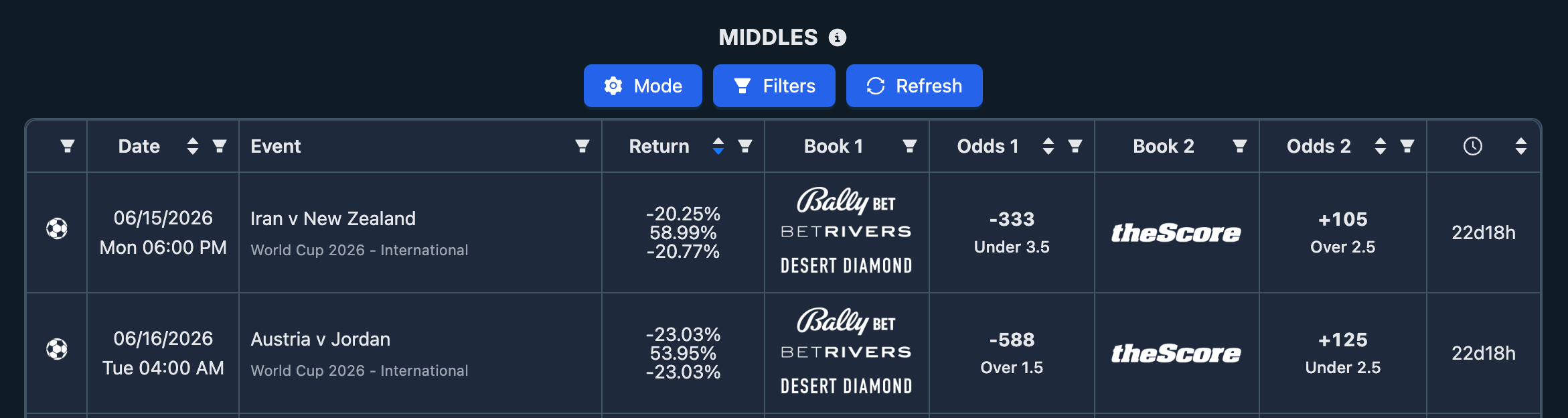
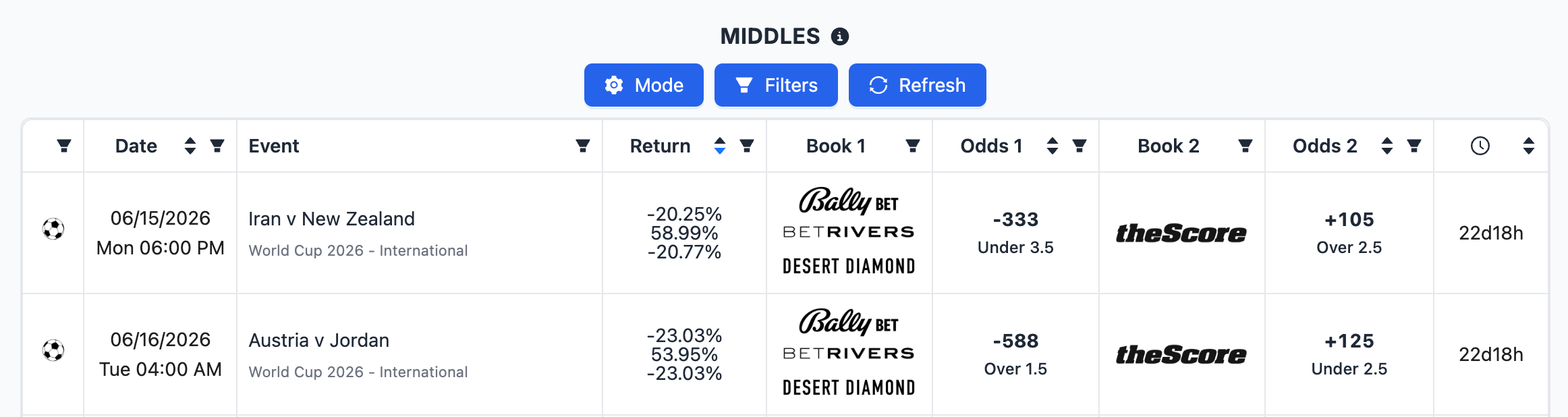
The table will show sportsbook combinations where a Middle is possible. Each row represents an opportunity where two bets overlap and create a middle scenario.
2. Choose the stake mode
Before placing a Middle, choose how you want to size the operation. The Middles has two main stake modes:
- Stake 1
- Total Stake
In Stake 1 mode, you enter the amount you want to place on Sportsbook 1. The calculator then shows the stake needed on Sportsbook 2.
In Total Stake mode, you enter the total amount you want to use for the full operation. The calculator then divides that amount across the sportsbooks involved.
3. Compare the available rows
After choosing the stake mode, compare the rows shown in the table.
A Middle has three possible scenarios:
- only Bet 1 wins;
- both bets win because the result lands in the middle;
- only Bet 2 wins.
For this reason, the Middles shows different return values for the same row.
The most important value is the middle return, because it shows what happens if the result lands inside the middle. The side returns show what happens if the Middle does not hit.
A Middle is usually more interesting when:
- the side losses are small;
- the middle return is high;
- the middle range is realistic;
- the odds were updated recently;
- the sportsbooks accept the required stakes.
A very high middle return can look attractive, but it is not always the best opportunity. You also need to understand how likely the middle scenario is and how much you lose if it does not happen.
4. Open the calculator
When you find a suitable row, click it to open the Middles Calculator.
The calculator shows:
- the stake to place on Sportsbook 1;
- the stake to place on Sportsbook 2;
- the result if only Bet 1 wins;
- the result if both bets win;
- the result if only Bet 2 wins.
The table helps you find the opportunity. The calculator tells you exactly how to place it.
5. Check the bets on each sportsbook
Before placing any bet, open the event on every sportsbook involved and check that:
- the event is the same;
- the market is the correct variant;
- the lines match what the Middles shows;
- the odds still match the Middles;
- the stake is accepted by each sportsbook.
This step is very important.
Middle opportunities can disappear quickly. If one sportsbook changes the line or the odds, the Middle may no longer exist.
6. Place the bets
Once everything is correct, place the bets using the stakes shown in the calculator. Try to place the bets quickly, because Middle opportunities can change or disappear in seconds.
7. Save the bets in the Bet Tracker
Once you have placed the bets, record the combination in the Bet Tracker so you can track profitability and sportsbook balances.
What data is shown in the Middles table
Each row in the Middles represents a sportsbook-to-sportsbook combination on two overlapping lines.
The table includes:
- Sport — the sport of the event.
- Date — the scheduled start date and time.
- Event — the game or event name.
- Return — the return values for the Middle.
- Sportsbook 1 / Bet 1 / Odd 1 — the first sportsbook, selection, and odds.
- Sportsbook 2 / Bet 2 / Odd 2 — the second sportsbook, selection, and odds.
- Last Update — how recently the odds were refreshed.
The Return column is especially important in the Middles because it does not represent only one result. It helps you understand the three possible scenarios:
- what happens if only Bet 1 wins;
- what happens if the Middle hits and both bets win;
- what happens if only Bet 2 wins.
The middle return is the potential reward. The side returns are the cost of the operation if the Middle does not hit.
The Last Update is also important because lines and odds can move quickly. A recent update is usually better, but you should still verify the odds and lines directly on each sportsbook before placing the bets.
Stake 1 and Total Stake
The stake mode changes how the calculator builds the operation.
Stake 1
Use Stake 1 when you want to decide the amount placed on Sportsbook 1. For example, you may want to place $100 on Sportsbook 1 because that sportsbook accepts that stake, or because you want to control how much money you use on that account. The calculator will then show the stake needed on Sportsbook 2.
Total Stake
Use Total Stake when you want to decide the total amount used for the whole operation. For example, if you enter $200 as the total stake, the calculator will divide that $200 between the sportsbooks involved.
Filtering the Middles
The Middles gives you different ways to filter the results. You can use filters to narrow the table by:
- sport;
- date;
- sportsbook;
- bet type;
- odds range;
- return range;
- event;
- competition.
This helps you focus only on opportunities that are useful for you.
For example, you may want to see only Middles from sportsbooks where you already have funds, only events starting today, or only opportunities where the side loss is small enough for your strategy.
Searching for or hiding events
You can search for specific events, teams, or competitions. This is useful when you want to focus on one game or when you only want to work with certain leagues.
You can also hide events or competitions that are not useful to you. For example, you may want to hide events from leagues you do not trust, markets you do not understand, or sportsbooks where you cannot place the required stake. Hiding irrelevant events makes the table easier to use and helps you focus on better opportunities.
How to choose the best Middle
The best Middle is not always the one with the highest middle return. A high middle return is useful, but you also need to look at the downside.
When choosing a Middle, check:
- the return if only Bet 1 wins;
- the return if the Middle hits;
- the return if only Bet 2 wins;
- the size of the middle range;
- how recently the odds were updated;
- whether you can use the sportsbooks involved;
- whether you have enough balance on each sportsbook;
- whether the market is easy to find;
- whether the stake is accepted.
A Middle with a very high possible profit but a large side loss can be risky. A Middle with a smaller possible profit but a very small side loss can be more comfortable to place. The best Middle is the one where the possible reward makes sense compared to the cost of missing the middle.
Using the Middles Calculator
When you click a row, the Middles Calculator opens and shows the exact betting plan. The calculator uses the stake mode selected in the settings, but you can still edit the values if needed.
You can adjust:
- the stake on Sportsbook 1;
- the total stake;
- the odds;
- any other settings available in the calculator.
The calculator shows the expected result for every possible scenario:
- only Bet 1 wins;
- both bets win;
- only Bet 2 wins.
If rounded stakes are enabled, the side results may not be exactly equal, so always review the final numbers before placing the bets.
Example
Imagine the Middles shows this opportunity on an NHL game between the Boston Bruins and the New York Rangers:
- Sportsbook 1: Over 5.5 Goals
- Sportsbook 2: Under 6.5 Goals
You select Stake 1 mode and enter $100 as the stake on Sportsbook 1.
The calculator then shows the stake needed on Sportsbook 2 and the three possible results.
If the game ends with 5 or fewer total goals, only the Under 6.5 bet wins.
If the game ends with exactly 6 goals, both bets win.
If the game ends with 7 or more goals, only the Over 5.5 bet wins.
You open the event on both sportsbooks and check that the game, market, lines, selections, and odds are correct.
If everything matches, you place both bets using the stakes shown in the calculator.
If the game ends with exactly 6 goals, the Middle hits and the operation produces its best result.
Saving filters with the URL
The Middles can keep your filters and settings in the URL. This is useful if you want to save a specific search setup or return to the same filtered view later.
For example, you may create a view that only shows:
- specific sportsbooks;
- specific sports;
- specific Middle markets;
- a minimum middle return;
- opportunities with acceptable side returns.
You can then save or share that URL and come back to the same setup.
Important checks and common mistakes before placing the bets
Before placing a Middle, always check the full operation carefully. A Middle depends on the exact event, market, line, odds, and accepted stakes. If one of these elements is wrong or changes before you complete the bets, the opportunity may no longer work as planned.
1. Check that the event is identical
Make sure both sportsbooks refer to the exact same event. Do not rely only on the team names. Check the date, time, competition, and market before placing the bets.
2. Check the market and period
Middles are sensitive to the exact market variant. For example, Over 5.5 Goals full game and Over 5.5 Goals first period are not the same market. Also be careful with different market types, such as totals, team totals, point spreads, player props, quarters, halves, periods, or alternative lines.
3. Check that the lines create a real Middle
The whole point of a Middle is the gap between two lines. For example, Over 5.5 Goals and Under 6.5 Goals create a Middle at exactly 6 goals. But if one sportsbook changes Under 6.5 to Under 5.5, the Middle no longer exists. Always check the exact lines before placing the bets.
4. Check that the odds are still available
Middles can disappear quickly because odds and lines can move. Always check the odds directly on each sportsbook before placing the bets. If one odd has changed, go back to the calculator and recalculate before continuing. Do not force the operation if the numbers no longer match.
5. Check that the stakes are accepted
A Middle only works as planned if each sportsbook accepts the required stake. If one sportsbook accepts only a smaller stake, the operation may become unbalanced. In that case, adjust the stakes in the calculator or skip the opportunity.
6. Check the side results
Do not look only at the middle return. The middle return shows the best-case scenario, but the side results show what happens if the Middle does not hit. Before placing the bets, make sure the side loss, if any, is acceptable. A large possible middle profit is not enough if the downside is too high for your strategy.
7. Use the correct stake mode
Make sure you understand whether you are using Stake 1 or Total Stake. If you enter the wrong value, the stakes shown by the calculator may not match the operation you intended to place.
8. Record the operation
After placing the bets, record the operation in your Bet Tracker. This helps you keep track of stakes, profits, balances, and results across many Middles.
Final summary
The Middles helps you find sportsbook combinations where two overlapping lines create a scenario in which both bets can win.
To use it correctly:
- Open the Middles.
- Choose the stake mode: Stake 1 or Total Stake.
- Filter the sportsbooks, sports, markets, and return range.
- Compare the rows and check the side returns, middle return, and line gap.
- Open the calculator.
- Check the event, market, lines, odds, and accepted stakes on every sportsbook.
- Place the bets using the stakes shown in the calculator.
- Record the operation in your Bet Tracker.
Used correctly, the Middles helps you find overlapping betting lines and calculate the correct stakes before placing the bets.
The most important thing is execution. The tool finds the opportunity, but you must still check the sportsbooks, confirm the lines and odds, and make sure the side results are acceptable before placing the bets.
How to use the Middles step by step
1. Open the Middles
Open the Middles from the NinjaBet tools area.
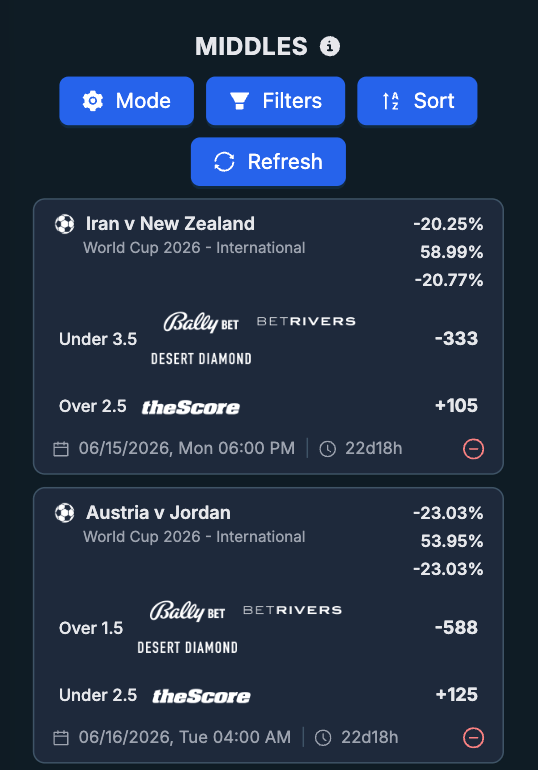
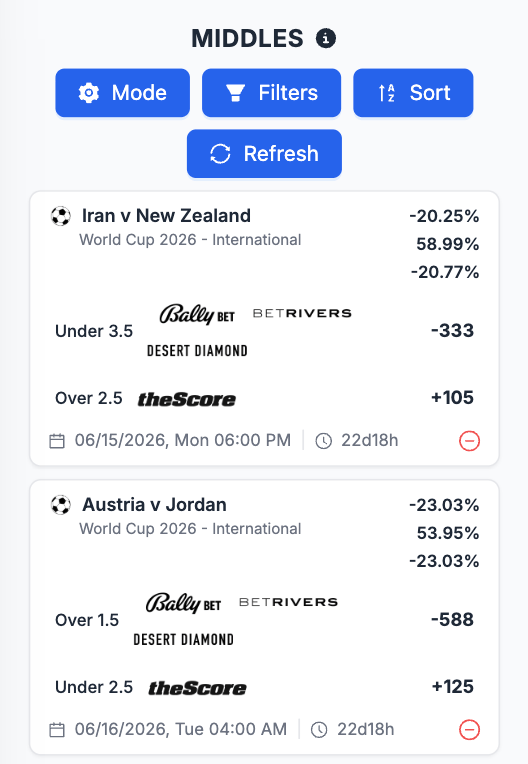
The table will show sportsbook combinations where a Middle is possible. Each row represents an opportunity where two bets overlap and create a middle scenario.
2. Choose the stake mode
Before placing a Middle, choose how you want to size the operation. The Middles has two main stake modes:
- Stake 1
- Total Stake
In Stake 1 mode, you enter the amount you want to place on Sportsbook 1. The calculator then shows the stake needed on Sportsbook 2.
In Total Stake mode, you enter the total amount you want to use for the full operation. The calculator then divides that amount across the sportsbooks involved.
3. Compare the available rows
After choosing the stake mode, compare the rows shown in the table.
A Middle has three possible scenarios:
- only Bet 1 wins;
- both bets win because the result lands in the middle;
- only Bet 2 wins.
For this reason, the Middles shows different return values for the same row.
The most important value is the middle return, because it shows what happens if the result lands inside the middle. The side returns show what happens if the Middle does not hit.
A Middle is usually more interesting when:
- the side losses are small;
- the middle return is high;
- the middle range is realistic;
- the odds were updated recently;
- the sportsbooks accept the required stakes.
A very high middle return can look attractive, but it is not always the best opportunity. You also need to understand how likely the middle scenario is and how much you lose if it does not happen.
4. Open the calculator
When you find a suitable row, click it to open the Middles Calculator.
The calculator shows:
- the stake to place on Sportsbook 1;
- the stake to place on Sportsbook 2;
- the result if only Bet 1 wins;
- the result if both bets win;
- the result if only Bet 2 wins.
The table helps you find the opportunity. The calculator tells you exactly how to place it.
5. Check the bets on each sportsbook
Before placing any bet, open the event on every sportsbook involved and check that:
- the event is the same;
- the market is the correct variant;
- the lines match what the Middles shows;
- the odds still match the Middles;
- the stake is accepted by each sportsbook.
This step is very important.
Middle opportunities can disappear quickly. If one sportsbook changes the line or the odds, the Middle may no longer exist.
6. Place the bets
Once everything is correct, place the bets using the stakes shown in the calculator. Try to place the bets quickly, because Middle opportunities can change or disappear in seconds.
7. Save the bets in the Bet Tracker
Once you have placed the bets, record the combination in the Bet Tracker so you can track profitability and sportsbook balances.
What data is shown in the Middles table
Each row in the Middles represents a sportsbook-to-sportsbook combination on two overlapping lines.
The table includes:
- Sport — the sport of the event.
- Date — the scheduled start date and time.
- Event — the game or event name.
- Return — the return values for the Middle.
- Sportsbook 1 / Bet 1 / Odd 1 — the first sportsbook, selection, and odds.
- Sportsbook 2 / Bet 2 / Odd 2 — the second sportsbook, selection, and odds.
- Last Update — how recently the odds were refreshed.
The Return column is especially important in the Middles because it does not represent only one result. It helps you understand the three possible scenarios:
- what happens if only Bet 1 wins;
- what happens if the Middle hits and both bets win;
- what happens if only Bet 2 wins.
The middle return is the potential reward. The side returns are the cost of the operation if the Middle does not hit.
The Last Update is also important because lines and odds can move quickly. A recent update is usually better, but you should still verify the odds and lines directly on each sportsbook before placing the bets.
Stake 1 and Total Stake
The stake mode changes how the calculator builds the operation.
Stake 1
Use Stake 1 when you want to decide the amount placed on Sportsbook 1. For example, you may want to place $100 on Sportsbook 1 because that sportsbook accepts that stake, or because you want to control how much money you use on that account. The calculator will then show the stake needed on Sportsbook 2.
Total Stake
Use Total Stake when you want to decide the total amount used for the whole operation. For example, if you enter $200 as the total stake, the calculator will divide that $200 between the sportsbooks involved.
Filtering the Middles
The Middles gives you different ways to filter the results. You can use filters to narrow the table by:
- sport;
- date;
- sportsbook;
- bet type;
- odds range;
- return range;
- event;
- competition.
This helps you focus only on opportunities that are useful for you.
For example, you may want to see only Middles from sportsbooks where you already have funds, only events starting today, or only opportunities where the side loss is small enough for your strategy.
Searching for or hiding events
You can search for specific events, teams, or competitions. This is useful when you want to focus on one game or when you only want to work with certain leagues.
You can also hide events or competitions that are not useful to you. For example, you may want to hide events from leagues you do not trust, markets you do not understand, or sportsbooks where you cannot place the required stake. Hiding irrelevant events makes the table easier to use and helps you focus on better opportunities.
How to choose the best Middle
The best Middle is not always the one with the highest middle return. A high middle return is useful, but you also need to look at the downside.
When choosing a Middle, check:
- the return if only Bet 1 wins;
- the return if the Middle hits;
- the return if only Bet 2 wins;
- the size of the middle range;
- how recently the odds were updated;
- whether you can use the sportsbooks involved;
- whether you have enough balance on each sportsbook;
- whether the market is easy to find;
- whether the stake is accepted.
A Middle with a very high possible profit but a large side loss can be risky. A Middle with a smaller possible profit but a very small side loss can be more comfortable to place. The best Middle is the one where the possible reward makes sense compared to the cost of missing the middle.
Using the Middles Calculator
When you click a row, the Middles Calculator opens and shows the exact betting plan. The calculator uses the stake mode selected in the settings, but you can still edit the values if needed.
You can adjust:
- the stake on Sportsbook 1;
- the total stake;
- the odds;
- any other settings available in the calculator.
The calculator shows the expected result for every possible scenario:
- only Bet 1 wins;
- both bets win;
- only Bet 2 wins.
If rounded stakes are enabled, the side results may not be exactly equal, so always review the final numbers before placing the bets.
Example
Imagine the Middles shows this opportunity on an NHL game between the Boston Bruins and the New York Rangers:
- Sportsbook 1: Over 5.5 Goals
- Sportsbook 2: Under 6.5 Goals
You select Stake 1 mode and enter $100 as the stake on Sportsbook 1.
The calculator then shows the stake needed on Sportsbook 2 and the three possible results.
If the game ends with 5 or fewer total goals, only the Under 6.5 bet wins.
If the game ends with exactly 6 goals, both bets win.
If the game ends with 7 or more goals, only the Over 5.5 bet wins.
You open the event on both sportsbooks and check that the game, market, lines, selections, and odds are correct.
If everything matches, you place both bets using the stakes shown in the calculator.
If the game ends with exactly 6 goals, the Middle hits and the operation produces its best result.
Saving filters with the URL
The Middles can keep your filters and settings in the URL. This is useful if you want to save a specific search setup or return to the same filtered view later.
For example, you may create a view that only shows:
- specific sportsbooks;
- specific sports;
- specific Middle markets;
- a minimum middle return;
- opportunities with acceptable side returns.
You can then save or share that URL and come back to the same setup.
Important checks and common mistakes before placing the bets
Before placing a Middle, always check the full operation carefully. A Middle depends on the exact event, market, line, odds, and accepted stakes. If one of these elements is wrong or changes before you complete the bets, the opportunity may no longer work as planned.
1. Check that the event is identical
Make sure both sportsbooks refer to the exact same event. Do not rely only on the team names. Check the date, time, competition, and market before placing the bets.
2. Check the market and period
Middles are sensitive to the exact market variant. For example, Over 5.5 Goals full game and Over 5.5 Goals first period are not the same market. Also be careful with different market types, such as totals, team totals, point spreads, player props, quarters, halves, periods, or alternative lines.
3. Check that the lines create a real Middle
The whole point of a Middle is the gap between two lines. For example, Over 5.5 Goals and Under 6.5 Goals create a Middle at exactly 6 goals. But if one sportsbook changes Under 6.5 to Under 5.5, the Middle no longer exists. Always check the exact lines before placing the bets.
4. Check that the odds are still available
Middles can disappear quickly because odds and lines can move. Always check the odds directly on each sportsbook before placing the bets. If one odd has changed, go back to the calculator and recalculate before continuing. Do not force the operation if the numbers no longer match.
5. Check that the stakes are accepted
A Middle only works as planned if each sportsbook accepts the required stake. If one sportsbook accepts only a smaller stake, the operation may become unbalanced. In that case, adjust the stakes in the calculator or skip the opportunity.
6. Check the side results
Do not look only at the middle return. The middle return shows the best-case scenario, but the side results show what happens if the Middle does not hit. Before placing the bets, make sure the side loss, if any, is acceptable. A large possible middle profit is not enough if the downside is too high for your strategy.
7. Use the correct stake mode
Make sure you understand whether you are using Stake 1 or Total Stake. If you enter the wrong value, the stakes shown by the calculator may not match the operation you intended to place.
8. Record the operation
After placing the bets, record the operation in your Bet Tracker. This helps you keep track of stakes, profits, balances, and results across many Middles.
Final summary
The Middles helps you find sportsbook combinations where two overlapping lines create a scenario in which both bets can win.
To use it correctly:
- Open the Middles.
- Choose the stake mode: Stake 1 or Total Stake.
- Filter the sportsbooks, sports, markets, and return range.
- Compare the rows and check the side returns, middle return, and line gap.
- Open the calculator.
- Check the event, market, lines, odds, and accepted stakes on every sportsbook.
- Place the bets using the stakes shown in the calculator.
- Record the operation in your Bet Tracker.
Used correctly, the Middles helps you find overlapping betting lines and calculate the correct stakes before placing the bets.
The most important thing is execution. The tool finds the opportunity, but you must still check the sportsbooks, confirm the lines and odds, and make sure the side results are acceptable before placing the bets.